Tuesday, November 28, 2006

Snowflakes

In honor of the first snow fall of the year in my home town, I present some snow factoids:

Is it true that no two snowflakes are exactly alike?


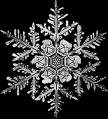
Yes, say researchers at Caltech. Kenneth Libbrecht, a physicist, has studied the growth of ice crystals in controlled laboratory settings. Ice crystals form around a speck of dust and grow differently depending on the air temperature and humidity. In real life, snowflakes float through the air where temperature and moisture constantly change. Just as no two people have the same developmental history, no two flakes have the same growth history so each is unique.

What causes pink snow?

While it's true that sometimes shadows cast on snow appear to have a pink hue, the bright pink almost reddish tint of "watermelon snow" is a totally different phenomenon. A certain species of algae, Chlamydomonas nivalis, produce a red pigment in addition to the familiar green-tinted chlorophyll produced by plants. This algae thrives in frozen water and when compacted, by stepping on it with a snow boot, the color intensifies. Watermelon snow can be seen in late spring and early summer in old, packed snow at around 10,000-12,000 feet in the Sierra Nevada mountain range in CA. The red tinged carotenoid pigmentation is what gives tomatoes, peppers, lobsters, corals, and shrimp-eating flamingoes their distinctive crimson color. You can see examples of pink snow here.

Snowflake, the Albino Gorilla

Snowflake, the world's only known albino gorilla, lived in the Barcelona Zoo. He was captured from the wild in the 60s in Equatorial Guinea when he was an infant and lived about 40 years in captivity until he died from cancer. He sired 21 offspring and 10 grandchildren, including twins.

Albinism is a recessive genetic trait so both of Snowflake's parents had to have the gene that causes the condition. The gene alters the amino acid tyrosinase which is a necessary building block for the proteins that pigment hair and skin.

Snowflake was not treated any differently by the other gorillas in his community on account of his odd skin and hair color -- a lesson we humans ought to take to heart.

Sunday, November 26, 2006

Pulling Rank

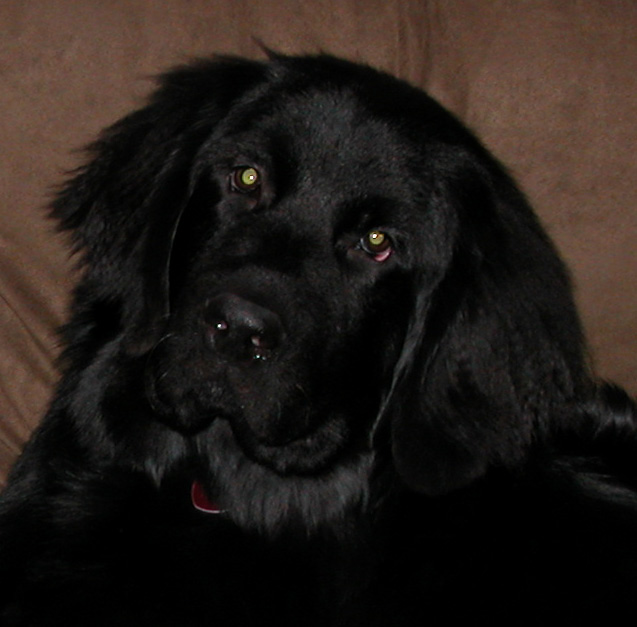
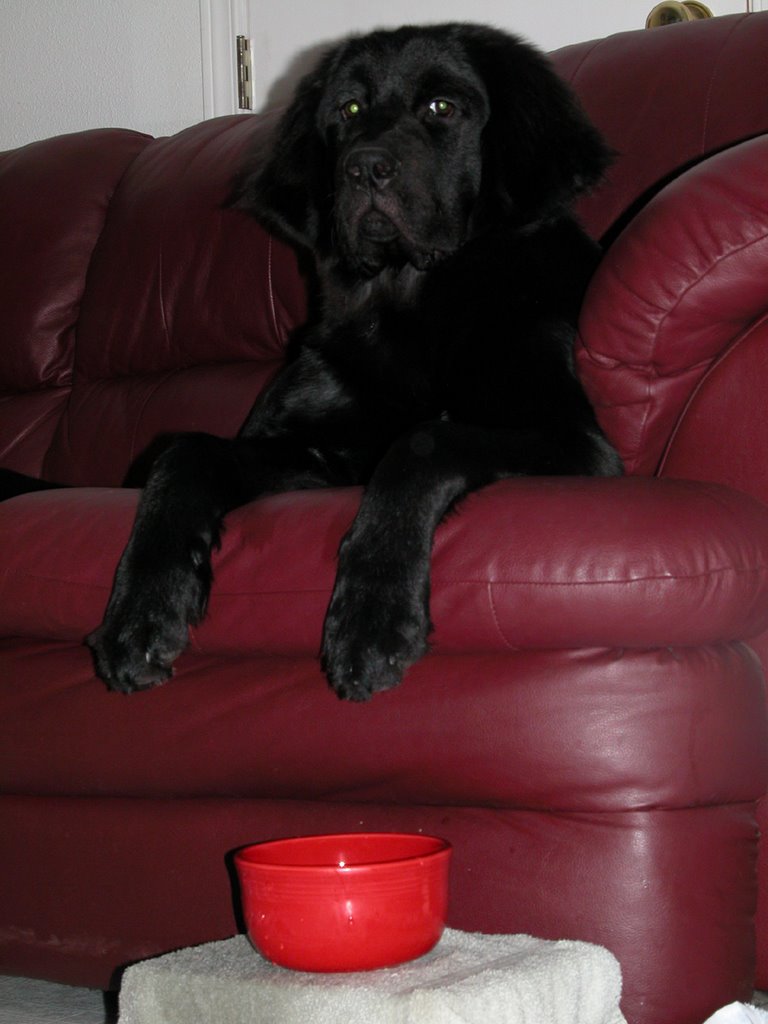
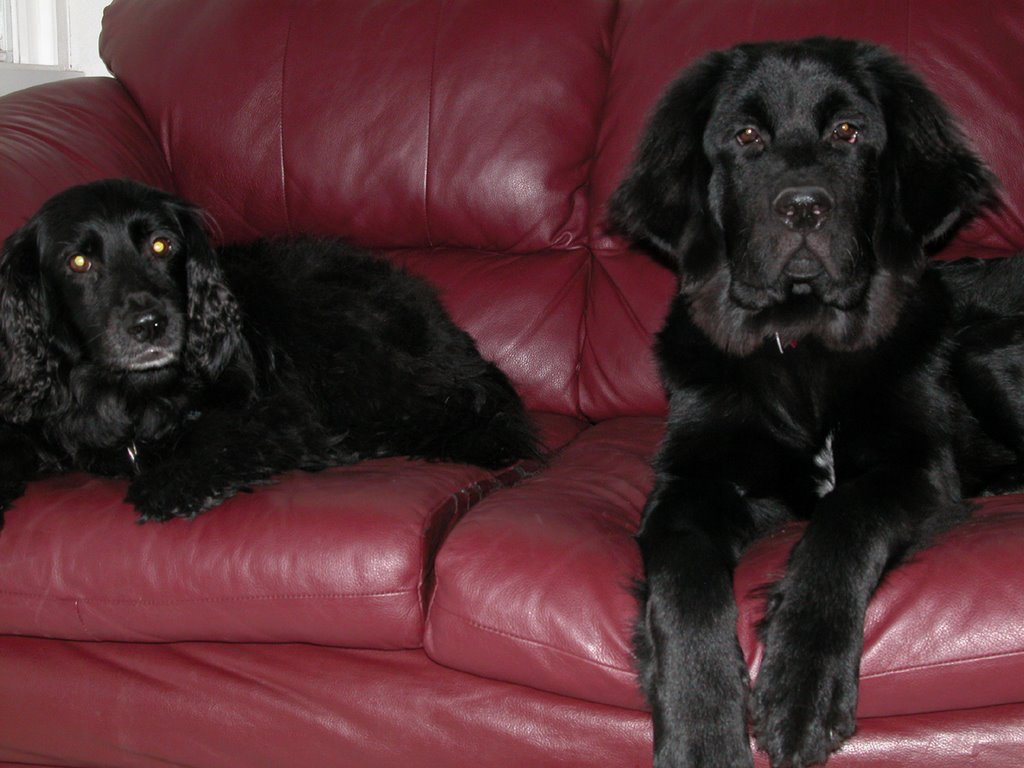
This morning, like other mornings recently, my thick skulled Newfie pup has taken to pulling weeds for me. Yep. I have got to find a way to harness her inclination. Right now it's an annoyance because she's picking up the dried ones I pulled long ago and eating them. I know, I know - I could go out and do some yard tidying, but if you saw the enormity of the job and the utter lack of its necessity the way I do, you'd throw in the proverbial towel too and resign yourself to emptying the contents of her mouth and jowls like I do.

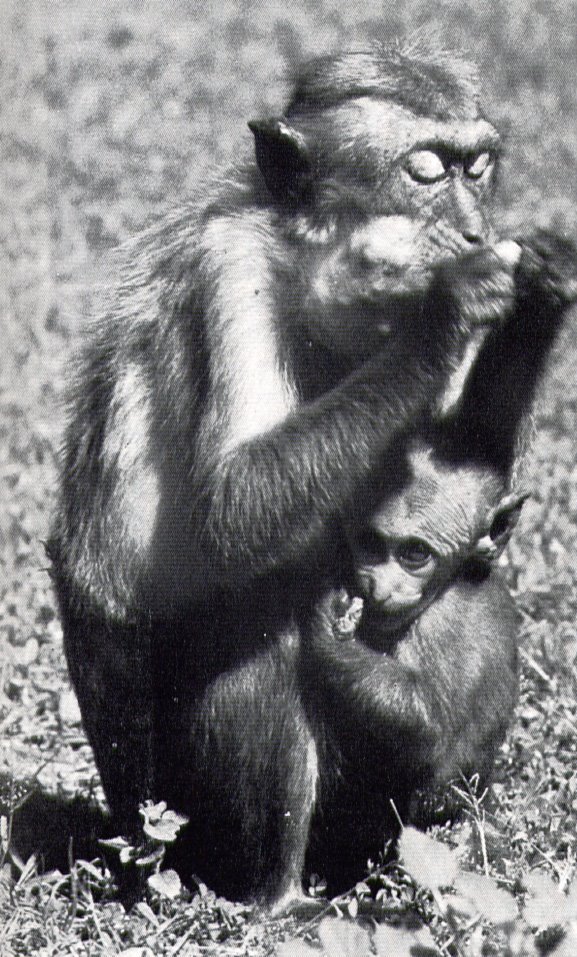
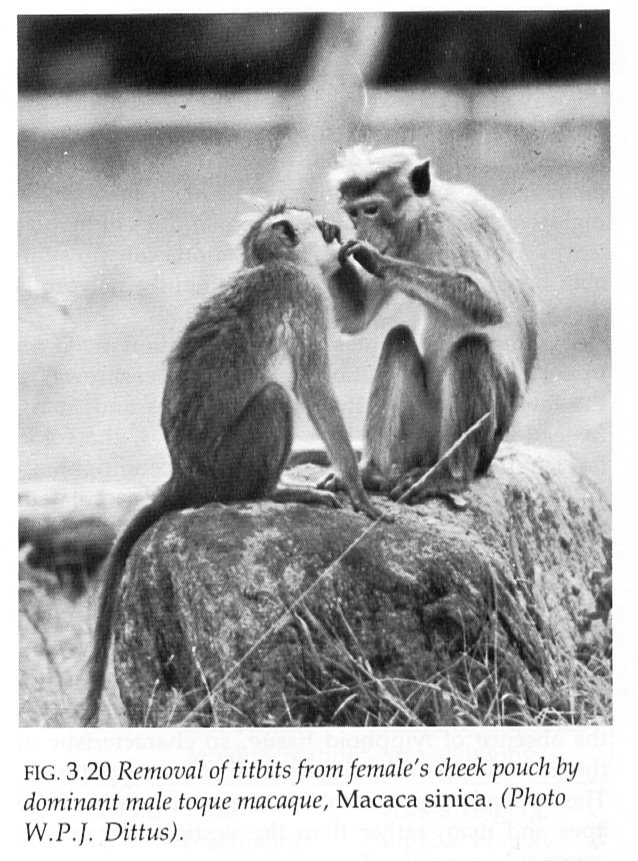
It all reminds me of old world monkeys (those who live in Africa and Asia like the macaques pictured to the left) who have cheek pouches they can use to store food for a time so they can eat it in peace away from higher ranking monkeys later.

Frequently, they lose the contents of their 'jowls' to monkeys who pull rank.

No one ever pulled rank on my feisty old dog when he was a juvenile, so when he gets hold of some illicit substance, a bribe and exchange is necessary.

If you don't want to be bitten each time you need to take something away from a dog, be advised to take things from them early and often, and often for no reason at all.

That way, when you have to assert authority you won't get a lot of flack in return.

The same thing works for people too, don't you think?

Friday, November 24, 2006

Animal Eyes

I can pass on "The Natural History of Weasels and Stoats" and also "Western Corn Rootworm," but a few of the other titles featured in the Oxford University Press catalog on Ecology and Evolution titles really look interesting. The most exciting to me is "Animal Eyes."

Back in my grad school days I took a class in stereopsis, the technical term for binocular vision, and chose to write my special project paper on binocular vision in animals other than mammals. Through it I learned that animal eyes are quite diverse, and a few are simply amazing.

We've all heard about the compound eyes of insects - the fancy conglomeration of hundreds of lenses in each eye that form a sort of mosaic tile perception of the world. Those are cool, but they don't provide any binocular depth perception because the lenses of each eye don't coordinate with one another in the organism's brain.

Instead, insects with compound eyes judge distance through monocular cues like texture gradient (finely textured objects are probably nearer), occlusion (if one object blocks another the one that is blocked is farther away), and motion parallax (moving your head from side to side simulates the "camera one," "camera two" effect of binocular vision).
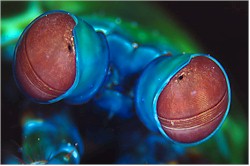
Other animal eyes are way more astounding. Take for instance the mantis shrimp. It has compound eyes but also achieves binocular depth perception within a single eye. Humans, like other animals, need two eyes to have binocular depth perception.

The band that can be seen running horizontally across the mantis shrimp eye separates the two distinct areas above and below. The top and bottom parts of the eye receive different visual inputs (kind of like a right eye vs. left eye), as does the middle band. These areas are coordinated in its brain. Even more amazing is that these three areas are also coordinated with the three matching areas in its other eye, giving it not binocular vision, but hexocular vision.

This animal may have the most complicated eyes on earth. And, that doesn't stop with its perception of depth. This critter also has sophisticated color vision. Whereas humans have trichromatic vision (corresponding to the three different kinds of photoreceptor cells we have in our retinas) that allows us to see light in a relatively narrow range we call the "visual spectrum," the mantis shrimp has four times as many kinds of photoreceptors that allow it to see a much broader spectrum of light, including polarized light.

To find out why these colorful creatures have such complex eyes, check out this entertaining and well-written NWF article.

Some people, such as those who adhere to the Intelligent Design school of thought, think the existence of such intricate biological systems is evidence of an intelligent designer.

The idea can be traced back to William Paley, a theologist who lived around the time that the pocket watch came into common use, who argued that the existence of god could be inferred from the apparent design of the world. He argued that no one, upon stumbling on a rock in a field, would question how the stone got there. But if we instead found a pocket watch, an object that shows evidence of design in that its individual parts work together to produce motion and can be used to keep time, then we would of course question its existence and infer that it had a maker and that it was produced for a reason.

The ID people look at biological systems this way, and not surprisingly, the eye is one of their favorite subjects.

Proponents of ID cannot accept that parts of an eye would be useful in isolation, however, they are. Eyes evolved in small incremental steps, probably starting with a cell that was sensitive to light, followed by patches of cells sensitive to light, then a lens to concentrate the incoming light on the most light sensitive patch, followed by lenses that could concentrate light more exactly, or more than one lens, and so on. No designer is needed, just random changes in DNA that turn out to be beneficial.

Of course one could always just say that the intelligent designer laid down the rules of physics and chemistry and meiosis and then went on permanent holiday never to be seen or heard from again. Questioning how and why the universe came to be in the first place seems to be a human universal, a sort of species typical trait. Perhaps it's the product of consciousness.
Wednesday, November 22, 2006

A Lesson on Acetylcholine From a Simple Eye Exam

Yesterday I had my eyes dilated as part of a routine eye exam. It's been a long time since I had my eyes dilated so I forgot about the side effects. To say that it's "a bit uncomfortable for the patient as it causes increased light sensitivity that lasts for several hours" greatly understates the experience.

According to the University of San Diego School of Medicine, "a non-dilated view of the retina is adequate for a general exam in which the patient has no specific ophthalmologic complaints." Had I only known that yesterday I could have avoided hours of distorted vision that made me queasy and gave me a headache. I did have sensitivity to light, albeit minimal, but elected to shut the lights off in my room anyway. That eliminated the sparkling rainbow halos around the lights which were no good to me anyway as my near vision was so blurry I could not possibly read or do sodoku. That's the real bothersome side effect - and one people should be warned about in advance. If you have to work or be at all productive for the rest of the day you'd be up a creek. Watching a movie was pointless too. I was tempted to call it good and go to bed early, but at five, that seemed crazy.

The short walk home from the doc's office wasn't much fun either. Car headlights looked like a giant Swarovski display case moving at high speed. I felt like how I imagined people must feel while on one of a variety of psychotropic drugs. And, I sort of was "on drugs."

The susbstance used to dilate pupils is a relative of the "belladonna" (beautiful lady) plant so called because the pupil dilation it causes makes people appear to be more beautiful. It's been speculated that people seem to grow in attractiveness with the size of their pupils because pupils naturally dilate when people are interested in something, or someone. Appearing interested makes the person seem more physically attractive. It makes sense - who wouldn't be a little more interested in a stranger simply because he (or she) seems interested?

The chemical, atropine, attaches to the same receptors on the cells of our body that acetylcholine uses. The main job of acetylchone is to contract muscles, whether it's the iris, our forehead or our limbs. When atropine binds to the receptors instead of acetylcholine, muscles relax. The pupil expands. So do the muscles that change the shape of the lens to allow us to focus on near objects in a process called accommodation. The resulting "paralysis of accommodation" simulates what people who need bifocals experience.

Atropine is not the only substance that acts as an acetylcholine antagonist (it blocks its function). Botulin toxin, the stuff responsible for botulism, relaxes muscles too. Small amounts of it is used in Botox beauty treatments to paralyze facial muscles so that they can't produce wrinkles. The chemical eventually wears off, as do the uncomfortable side effects of atropine. Curare, extracted from the bark or a South American tree, is used to poison blow gun dart tips. When curare enters the bloodstream, internal muscles relax and death from asphyxiation can result.

Saturday, November 18, 2006

Christmas Wish List

Every year I have such a hard time figuring out what to get everyone for the holidays. Gift exchange is an important tradition, I think, but as much as picking the perfect surprise gift for everyone is ideal, it doesn't always happen. Last year I found four perfect gifts for my MIL. She loved them and said something like "Holly really knows me." Little did she know that it took 9 months and a lot of luck to stumble on the perfect thing. That almost never happens, so I think it would be really helpful if they all kept blogs and put up a post right about now about what's on their wish list to give some ideas for those years when the perfect thing didn't cross my path.

Here's what's on mine:

Coleman Big Red Plush Oversized Ball (for the Baroness von Roughenhausen who LOVES balls but has none - she's not supposed to play fetch with tennis balls because Newfies can choke on them)

Aquolina Pretty In Pink Gift Set (I got a sample from Sephora a while back and loved it)

set of pastel pencils like these (probably easy to find at Art Media in PDX) along with something to gently fix it in place on the paper so it doesn't smudge, and a good pencil sharpener

several sheets of good quality drawing/painting/pastel paper around 18x18in large

Black Currant Vanilla lotion from Bath & Body Works

incredibly soft sheets (Queen size) and pillowcases in burgundy or light olive (I have yet to find them... My pillow, whatever fabric it's made out of, is what I'm looking for. Anyone know what composition of fabric to look for to get really soft sheets?)

iTunes gift certificate

a tall, narrow crystal bud vase (I like the looks of this one)

Starry Night Victoria's Secret flannel p.j.s (XS) with matching slippers (free if ordered before Dec 5)

Dolce & Gabbana Light Blue Body Cream (enter code CIRQUE4 at Sephora to get nifty gift bag for free)

Kenzo Flower Pearly Poppy Cream

An extremely neat puzzle box from Japan.

Thursday, November 16, 2006

Wheels For Pets

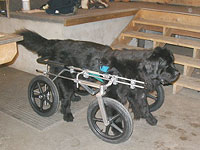
I stumbled on this company, Eddies Wheels For Pets, that makes wheel chairs for dogs who need help wheeling their hind ends around. I sometimes wonder whether Katy has dysplastic hips. It's a problem that runs in the breed. She came with a hips replacement warranty that means we will get a replacement Newf if her hips turn out to be so bad that she needs to be "put down" before she's two. I've already grown really attached to her so that would be horrible. It's nice to know there's something out there for her if she needs it. The photo shows a 120 lb Newf who used the wheels while recovering from spinal surgery. She now gets around without the wheels.

Yesterday's newspaper carried a story about China's new one dog policy to combat the spread of rabies. Not only are people not supposed to have more than one dog, but the one dog they can have has to be smaller than 14 inches. I think Max would barely qualify. A Newfoundland is out of the question. Why can they not just have the dogs vaccinated against rabies with a certificate of proof? I'm glad I'm not Chinese, and I'm also glad I'm not so naive to actually think that the war in Iraq has anything at all to do with safeguarding the freedom, like owning more than one dog, that we enjoy in the US. What I wonder is why the reporting never gets into why so few dogs in China are given rabies vaccines. Katy has actually been vaccinated twice for rabies because her vet office screwed up and vaccinated her again instead of Max.

Lately she has shown signs that she'd enjoy having a job. She is a working breed afterall. It's been very windy here lately. On a walk a few nights ago we saw a huge tree limb had crashed down on the roof of a house in our neighborhood. The wind has calmed down but the sidewalks are still littered with branches. Katy loves to swipe them and carry them around for the duration of her walk. She fit 4-5 good sized ones in her mouth the other night. One was about 5 feet long. We don't have a fireplace so bringing home kindling is cute but not terribly helpful. My Man With Gills thought it would be fun to outfit her with a blue and white U-B logo-d jacket to carry newspapers around for delivery. His newspaper is offering ten bucks for every new subscription an employee drums up. I wonder if Katy would be good at selling Newfpapers.

Wednesday, November 15, 2006

Human Family Walks on All Fours

Last night while flipping through channels I happened on a PBS/BBC program "The Family That Walks on All Fours" about five siblings in a Turkish family that walk on their hands and feet. Quadrupedalism is totally normal up until a certain age for humans, but then around a year old, we start to walk bipedally. It's not very coordinated at first but eventually humans get it. It's one of the things that makes humans unique in the primate world.

How and why humans became bipedal has been the subject of much debate. There still isn't a single theory that is accepted. Some think we stood up to stay cool (less body surface exposed to the sun), that walking upright allowed us to travel long distances more efficiently, enabled us to spot predators, use tools, carry food, babies, etc.

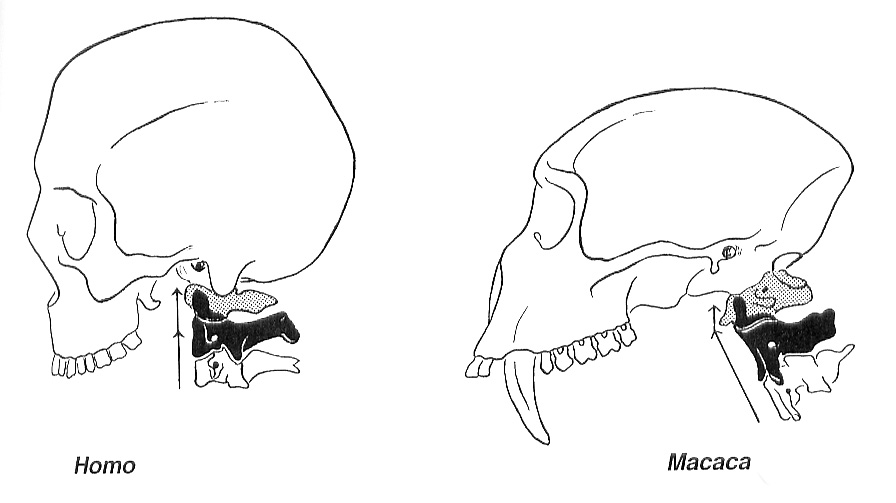
What we do know for certain is that walking bipedally coincided with a change in where our spinal column enters the skull (through a "big hole" called the foramen magnum). All other primates have a spinal cord that attaches to the brain at about a 45 degree angle; a human's does so at about 90 degrees.

This shift also altered the way the throat muscles and vocal tract are situated, giving humans an ability to utter a wider range of sounds than other primate. Thus, walking bipedally could ultimately be responsible for why humans have speech and language.

The program interviewed some scientists about whether they thought this family could provide some clues about the evolution of upright walking. Of course they can! One thought they could if the afflicted people had a genetic abnormality that kept them unable to walk upright. I think it could be that this hypothetical genetic sequence, or one nearly like it, is actually normal for other primates whereas humans carry a mutation.

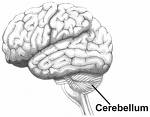
Another scientist thought this family suggests nothing about the evolution of bipedalism because the kids learned to walk on all fours in response to a cerebellum problem. They have "cerebellar ataxia," a condition that can be congenital but also can develop in response to a virus, in which case the condition tends to resolve itself. Cerebellar ataxia produces symptoms consistent with being excessively drunk. Alcohol, like any damage to this vital portion of the brain, interrupts the cerebellum's job of keeping our muscles coordinated. Effects include slurred speech, poor balance, and an inability to walk in a straight line. That's the real, key genetic aberration.

I think there's no doubt these Turkish kids have seriously abnormal cerebellums. They also can't really be compared to normal quadrupedal primates. If chimps had the cerebellum problems these kids have, they would have routinely fallen out of trees and would never be alive today. However, I'll at least reiterate that the cerebellum is involved in the evolution of upright walking. Whatever changes occurred in the cerebellum, those changes are part of what made it possible for humans to walk upright in a more coordinated fashion over long distances and have more control over our tongues. It's not just the so-called "language centers" of Broca's and Wernicke's areas that permit human language, it's also the cerebellum. Walking and talking go hand-in-hand.

When thinking about how human bipedalism might have evolved, primatologist take quite an interest in something called "facultative bipedalism" (walking upright when it's necessary to do so). "Faith," a truly amazing bipedal dog (see YouTube clip below), provides a textbook example of facultative bipedalism. The Turkish children featured in the documentary show what I'd call facultative quadrupedalism; they walk on all fours out of necessity.


Faith reminds me of people who learn to use their feet like hands. Our feet don't appear to be as useful as our hands, but with enough effort and time, they can function nearly the same as hands can. Big toes *can* be opposable, when they're needed to be. Not having full use of arms/hands would have put pressure on ancestral humans to walk upright. Perhaps our ancestors' hands were full carrying food or babies and those who had a genetic sequence that allowed them to walk upright longer and more efficiently were able to forage more successfully and outrun predators. Thus facultative bipedalism became the habitual bipedalism we see today.

Tuesday, November 14, 2006

Infant Reflexes

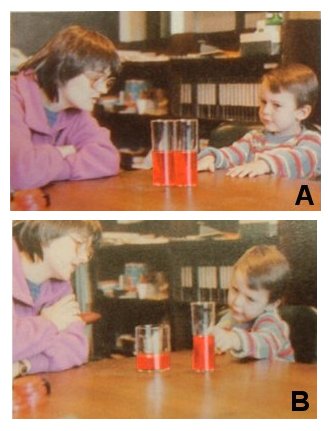
When I think about ways to spice up my intro psych class, I am reminded of a video clip I overheard while returning to my office one day. My colleague was showing his class the home movie he made of his daughter failing to demonstrate "conservation," an understanding that the number of items (M&Ms, coins) doesn't increase simply because they are spaced out more or that the amount of juice in a cup doesn't increase because it has been poured into a narrower cup. It's considered to be a major cognitive milestone that kids achieve around 5-6 years of age. (Adult apes demonstrate conservation too, but monkeys don't.)

Anyhow, the class really enjoyed seeing an abstract concept realized; I think, or they just like watching videos that show young children can't grasp the most elementary of concepts that they all take for granted. One of the great advantages of having kids as a psych prof is that you can actually make a repository of videos of your own kid's infant reflexes, Piagetian tasks and oh, I don't know, various Freudian things that kids are bound to do, like saying they want to marry daddy when they grow up.

My SIL just had a baby, and my sister is expecting one in March, so I suppose I could enlist their help in making footage for my class until I have a subject of my own to work with. (Hint! hint! ) My furry monster canines just won't cut it for the infant reflexes and Freudian departments, but they do a decent job of demonstrating Piaget's "object permanance." Out of sight is nowhere out of mind for Max when it comes to a treat, let me tell you!

One of the reflexes that I find particularly fascinating from an evolutionary standpoint is the "Moro reflex." When an infant is startled or loses head support, the baby's arms fling straight out to the side, fists close, and then come back to the chest as you'd expect to happen if a primate needed to quickly grasp mom's hair in case of emergency. This happens for the first 3-5 months after birth and is one of the most convincing examples that we are primates whose ancestors were hairy.

Infant reflexes can be used to gauge whether the infant has a normal central nervous system. Besides the Moro (no connection to the delicious blood "moro" oranges I love), there's also the Babinski, rooting, stepping, and one I'd nver heard before looking into it today: the swimmer's or "Gallant" reflex. Hold the baby prone supported by your hand on its belly. Stroke one side of the baby's spine. The baby should flex its body toward the stroked side.

The video below (found on YouTube) isn't a perfectly textbook example of the Moro reflex, but I think it comes pretty close. I also think this baby looks too thin!!

Tuesday, November 07, 2006

Newfoundlands Are Supposed to Like Water!!

This morning brought another day of pouring rain and with it, bizarre behavior from my Newfoundland puppy. Perhaps the weather doesn't agree with her now that she has made it through her first hot, dry Walla Walla summer. Usually the climate here is decidedly non-maritime; it's nowhere near the blustery cold she was bred for which explains her penchant for flopping down right on top of the AC vents whenever they're blowing out icy cold air. She butts in on anyone having a shower, seeming to get her head drenched on purpose. She'll find any water main no matter how covered with grass or weeds. Loves the water hose! You'd think she was a real bona fide Newfie.... until the rain. For the last two days the air has been warm and humid. It's been raining virtually non-stop and today when I tried to take her out for her post-breakfast poo she had other ideas.

I was standing in the yard getting soaked looking back at a Newfie, feet so firmly planted on the porch you'd think she was stuck in hardened concrete. She wears a very serious expression most of the time, but the look she shot me this morning told me I was crazy if I actually thought she'd go get wet out there!!! She reluctantly got off the porch, made a 6 foot loop and then promptly ran back up the ramp and glowered at me again. So we repeated those steps, making a bigger loop each time until she finally peed.

She's got a water proof coat! She loves to get her head wet in the shower! She put her feet in her water dish until we elevated it to stop her attemps to make her own pond in our kitchen.

So what is going on with this kid?

We came back inside; I toweled her off, wiped up the muddy floor, and started a load of dog towels. We go through them very fast. We need towels for drying her feet off, wiping up her "drool fangs," wiping up the puddles left on the floor after she gulps mouthfuls of water from her dish and lets half of it spill out of her jowls as she runs off, and lately, drying up her piddle problem. We need towels for wiping off the slime she leaves on the furniture. It all adds up to an extra load of wash now and then. It's no big deal, she more than makes up for the little bit of extra work.

Speaking of towels, her latest game is to run around with full sized towels. She stuffs her mouth full of one corner and runs off trailing the rest behind her, sometimes getting flustered or tripping because she doesn't realize she's standing on it. I like to toss the towel end over her back so she looks like she's biting a cape that she's wearing when she runs by. It's really very cute and almost impossible to get a picture of so you'll just have to take my word for it.

A long time ago when I stayed with a friend who had backyard pool in Scottsdale I got to witness a most amazing dog - a very sweet blonde Lab. She'd ask politely to go for swim by bringing you a towel.

If only Katy would view going out in the rain as a fun "swim" she could bring her own towel to the door.

Friday, November 03, 2006

Publication Progress & SLAC application advice

This week I sent a manuscript off to one of the best journals in my field. I should hear something fairly soon as this journal lets people know right away if their stuff doesn't warrant consideration. We'll see! I found a co-author who revamped sections of the lit review and discussion. I think it's an improvement.

I've got another manuscript I can submit once I tidy it up. My co-author is interested in working on this one too. One of my honors thesis students analzyed some data I had collected but hadn't done anything with yet. She floundered around for an idea of her own before asking me if I had any projects she could work on. Her thesis needs major revamping to be fit for submission. The lit review is way too long and goes off on tangents that aren't immediately relevant. She didn't incorporate any of my previous work so that needs to be brought in. These are both bones of contention that I had with her thesis.

This is the first time that I've had a thesis student base her work on mine. I thought it would be smooth but was actually a major time suck. Every weekly meeting went on for at least an hour; other students took half that time. I found myself giving her the conceptual framework for her thesis, the hypotheses, suggestions for data analysis, and even data interpretation. These are things I expect thesis students, especially honors students, to handle fairly well on their own - with the refinement coming from me. Her oral defense went all right and she managed to eke out passing with honors because I argued her case. I went to bat for this student. If I hadn't, she most certainly would not have received honors. Her thesis is a mess mostly do to clunky writing. The premise is solid though, and the data backs up the theory surprisingly well. Everything but the methods and results sections needs to be scrapped.

I think she deserves to be third author on this paper. She analyzed the data and I will use major portions of her methods and results sections. She also entered all of the data which includes responses from a population that was not analyzed for her thesis. Potentially two papers could come out of that data, which would be very exciting.

This would all be very helpful in my applications for positions at small liberal arts colleges (SLACs). They invariably want you to show that you can involve students in your research program. I have a very good record of this stretching back to grad school. I think I've worked with a dozen students over the years and have had three of them present our research at national conferences. To publish with one before being in a tenure-track position would be quite a coup as that usually doesn't happen until you've been in that position for a while. Then again, people don't usually get to hold positions at stellar SLACs without having a PhD, but I did it twice!

If I could offer advice for anyone wishing to go the SLAC vs Big Research University(BRU) route, I would suggest:

1) have an undergrad degree from a SLAC (it implies you know why they're special and will come in supporting the different nature of SLACs). If you don't have that, you can still get a favorable look from SLACs if you:

2) have experience teaching your own course, preferably courses. You need to have strong student evaluations from these courses as well.

3) show you can involve students in your research by having undergraduates work with you as research assistants, independent study students, etc while you are in graduate school. If you can co-author a paper or conference presentation with them, that is very, very helpful.

These are the three things that I think helped me get the positions I had, but it also seems that at least among the top-tier SLACs now, the direction they're going seems to be in the direction of wanting the BRU research capability at a small college with superb teachers. I don't know how they're going to pull that off -- it is true that research takes time away from teaching and vice versa, but if you want to be competitive for positions at top-tier SLACs, you need to have all of the above plus have a PhD from a big name BRU, a number of publications in reputable journals, and a well-developed program that will produce publishable results with undergraduates as assistants until you earn tenure.

Given that that's the route SLACs are going, #1 is far, far less important than 2 & 3. If you've got #1, you'll probably fit the culture of the place better. I've seen a few colleagues say and do some really inappropriate things to students because they failed to appreciate what is expected of them in a SLAC environment. Never blow off a student you run into outside of 'school hours' by telling him or her that you're "off the clock." If you work at a SLAC, you are never really ever off the clock. Students choose SLACs because they want accessible faculty. They want to own you. So, if you don't mind signing your life away to the demands of 18-22 yr olds, and instead relish being hounded by students when you're not even at 'work' to answer their questions about a lecture you gave, an upcoming test, or some random academic or personal question - by all means, apply!

Wednesday, November 01, 2006

Cranberries

The Today show featured a short segment on cranberries and bogs. The announcer really wanted the cranberry grower to explain how the whole bog thing works, but all he could do was point out some short bushes with little red berries. Left hanging on the vine was the question of how one goes from there to the picturesque water filled bogs. I wondered the same thing myself, so here's what I found out about cranberries. They're really interesting berries. (I still don't think they taste particularly good!). The berries are harvested by flooding the field they're grown in (a bog that has peaty, acidic soil) and then agitating the water with this device to loosen the berries. The floating berries are then sluiced from the surface.

Cranberries are native to New England and grow well in acidic soil (just like azaleas & rhododendrons). The name is probably a variation on the colonial "crane berry" so named because the flowers resemble the sand cranes that could be seen eating them. The Ocean Spray company produces 90% of the world's supply, grown in northern climates (MA, WA, OR, BC) only because milder climates create problems with fungus.

Cranberries are also well known for promoting urinary tract health. And, it's not all hype. In 2002, JAMA reported a study that suggests persistent urinary tract infections that are resistant to antibiotics could be prevented by drinking cranberry juice. The researchers found that cranberry juice prevents 80% of bacteria from attaching to the cells of the urinary tract. These anti-adhesion effects have been isolated to compounds called proanthocyanidins - yep, a cyanide relative. Cranberry juice is a real, viable alternative to participating in the evolution of antibiotic resistant bacteria.

Speaking of that, recently my Newfie puppy had to visit the vet for what they labeled a bladder infection. They allegedly did a test that showed she did have an infection, and of course, sent us home with antibiotic pills. She still dribbles. So, now I'm thinking it wouldn't hurt to put her on a cranberry juice routine. She may not like the tart treat as much as she enjoyed that peanut butter pills, but maybe it would be a good long-term solution.

The Cranberry Institute reports that the bacteria that cause periodontal gum disease are also sensitive to cranberry juice. That seems like good reason enough to drink the stuff, but did you know that blueberries are just as good?

Blueberries, in addition to having the anti-adhesion properties of cranberries, also have anti-proliferation capacity. They prevent cancer cells from replicating. Cool.

And, blueberries taste much better!

The Rutgers Blueberry and Cranberry Research Center is working to breed berries that have higher concentrations of medicinal properties.

Tuesday, October 31, 2006

Elephants Have Self-Concept

The Proceedings of the National Academy of Sciences will be releasing a study soon that shows elephants can recognize themselves in a mirror.

Among animal psychologists this is taken as evidence that they have a sense of self, a self-concept. Researchers gave three captive elephants the mirror and mark tests that were invented in the 70s by Gordon Gallup, a psychologist. Animals who don't recognize themselves in the mirror either ignore it or attack it. Those who do understand they are looking at themselves often inspect parts of their bodies that they can't normally see.

Chimps check out their behinds, the inside of their mouths, and their eyes. Elephants evidently do the same thing. The mark test is a variation on the mirror test. Visible and invisible paint is placed on either side of the individuals head and then observers watch to see whether the painted animal touches the visible paint spot but not the invisible one.

Members of all great ape species (chimps, bonobos, gorillas, orangutans) have passed these tests, but not all individuals do. Infants and juveniles don't "get it" and neither do infant humans. There is some developmental process that has to happen first, but at some point in time, usually by their first birthday, all normal humans understand the mirror image. Adult dolphins are the only other non-ape to pass these tests — that is up until now.

What's really amazing is that through evolution by natural and/or sexual selection, three very different kinds of critters all wound up with an ability to understand themselves. I wonder if this means they are conscious beings. Do they think about themselves? What do they think?

A while ago when Marc Hauser, a monkey psychologist who has done research on captive marmosets, released his book *** Wild Minds (excellent!!) the NY Times ran an article with a sidebar on testing your dog for self-concept. Max flunked it miserably. As far as I can tell he thinks mirrors are utterly boring. When we got our new pup I was keen to observe her in front of mirrors. We hadn't hung one of ours yet so it was on floor level with her. She was very, very interested in it but didn't do anything that confirmed in my mind that she knew she was looking at herself. I think she may have thought it was one of her litter mates. When we walked her around campus the first few times, she'd spot her reflection in the windows of doors. I think her reactions to them speak more of her outgoing, interested-in-other-dogs personality than her self-concept. Perhaps she does know the image is her, perhaps not. Either way, it's still fun to watch her watch herself. For that matter, it's also fun to watch her watch TV. She really loves dogs and balls. Max never pays attention to TV. Because of these differences I find it hard not to think that Max's new pal is smarter than he is. I think we humans assume that anytime another animal does something human-like that means it's "smart" even if it's a dumb as watching TV.

Some headlines on the elephant self-concept story reflect this assumption.

*** Adult captive cotton-top marmosets have passed these tests according to Hauser's research. He used day-glo neon pink Manic Panic hair dye to color the marmosets' stark white mohawks. This got them to look in the mirrors long enough to realize themselves staring back. Monkeys perceive direct eye contact as a threat (as do dogs) so their instinctual response is to retreat or attack. If they could just get over the eye contact part of it, it's possible that species who respond to eye contact this way would be able to "pass" the tests.

Feral Children

From Romulus & Remus, the mythical founders of Rome, to Mowgli, immortalized by Rudyard Kipling, stories of children raised by animals fascinate students the fictional boyof introductory psychology. The Legend of Tarzan isn't complete fiction. There are plenty of real cases of "feral children" who have grown up to be something other than human, halfway between man and beast. The children seem genuinely wild; having no language, they communicate only in grunts resembling the sounds of whatever animal raised them. Many crawl rather than walk. It takes years to socialize them to live semi-normally among humans and many never learn to talk.

One of my enterprising students showed me this neat website devoted to feral children.

Some wild children have been raised in isolation, as was Genie, who was kept in a closet most of her life with no interaction with anyone. She is probably the best known case of a wild child in this country, but looking at this list it's clear she's got no shortage of company. It seems that many feral children turn up in India. "One explanation is that women with young children or babies would leave their infants at the edge of a field while working, and wolves would emerge from the forest and steal them," says the feral children website.

I think these cases are fascinating because they reveal just how vital early experience with other members of our species is to normal human development. Without contact with others of own kind, particularly adults, humans don't grow up to speak, walk bipedally, or wear clothing. It's not 100% instinctual to do so.

These stories also demonstrate that some animals, dogs and primates, may actually take care of a human infant. One theory is that maternal care is instinctively "released" by cuteness (small body, big head, large eyes, soft wimpers) and that humans are sufficiently cute to some other animals to stimulate the maternal instinct to care for them. It's a little like a vireo feeding the cherry red gaping mouth of the cuckoo who parasitized the nest simply because it's instinctual to drop food into a gaping mouth. Brood parasitism is one of the neatest things that happens in the animal world.

Wednesday, October 25, 2006

Soy & Phytoestrogens

Last week I finished reading an article from Hormones and Behavior about the metabolism of hunger and sex drive. Within it, I learned some more interesting factoids about the consequences of ingesting soy. I think I drink a lot of soy, and I also eat tofu occassionally, so I am interested.

I'm still trying to wrap my head around the wide-ranging article, to fit the pieces together myself, so I'll just report some of the more interesting elements of the story.

1 - Fat cells have estrogen receptors! Mice without working estrogen receptors become obese.

2 - Body fat distribution is more critical to long term cadiovascular health than body fat content or BMI. Gluteofemoral fat deposits are cardioprotective. So, if you have an hourglass figure (narrow waist with wide hips and fleshy butt and hips - an hourglass/pear figure rather than an apple) you're at reduced risk of heart disease. Also, women with a .70 waist to hip ratio (the hourglass figure) have higher fertility.

3 - Insulin levels are associated with visceral (deep belly) fat, whereas leptin levels are associated with subcutaneous gluteofemoral (butt, hips, thigh) fat. Hormones of the HPA axis (hypothalamus - pituitary - adrenal glands), such as cortisol, are also implicated in body fat distribution. Stress may cause you to put on more visceral fat.

4 - Eating disorders (of which the author seems to be primarily interested in obesity) may arise from changes in neural sensitivity to estrogen that occur early in brain development.

5 - These changes might be intitiated by exposure to phytoestrogens in our diet and pollutants.

So, evidently, consuming soy is cardioprotective and reduces the risk of developing obesity only when consumed as an adult. BUT - and this is a big but - consumption of soy during pregnancy or exposure of a fetus to soy and phytoestrogens actually increases the risk of cardiovascular problems and obesity.

Pregnant women and infants should not consume soy or any products containing phytoestrogens because the phytoestrogens bind to the body's estrogen receptors in the brain, various internal organs, and particular body cells like fat cells. This leads to organizational changes in the infant's brain that masculinize a female's body fat distribution after puberty: more visceral fat around the waist, less around the hips and butt. This places her at greater risk of developing heart disease and obesity.

The paper, however, focused on an evolutionary theory that there are brain mechanisms dependent on hormones that serve to signal an animal when it's time to eat vs. mate. The author explored the metabolic control of hunger inhibition, arguing that such a mechanism is adaptive because it would "bring the cessation of hunger and eating long enough to find and court potential mates." She suggests that the hormone leptin, known as a hunger hormone because high levels of it inhibit appetite, should come to be viewed as a sex hormone too. Evidently, leptin enhances sex behavior - in rats and mice. It stimulates the preference of having sex over eating. The author also argues that the hormone neuropeptide Y which is known as an appetite stimulant, should also come to be viewed as a sex hormone that stimulates the preference for food over sex.

Monday, October 23, 2006

Psychology News Roundup

We all have ideosyncratic facial expressions. My guess is that more than once you've realized that you exhibit some of the same facial mannerisms your parents do. I noticed a while ago that I purse my lips the same way my mom does. Not so long ago my husband commented during a conversation that I had just made a facial expression that is typical of my youngest sister. I really didn't believe him. How could I have picked that up from her, or her from me? We have never lived together and haven't spent a ton of time together. Do families share similar facial expressions? If so, why?

A recently released study in the PNAS suggests there is a genetic basis for shared family facial expressions.
Read more.

*****
In other news, Giant Pandas appear to have some capacity to see in color! Read more here.

*****
Charles Dickens had a keen eye for the observation of neurological disorders, so perfectly describing the symptoms of Tourette's, Parkinson's and "restless legs syndrome" that medical reference texts at the time used his character desciptions. Although he had no formal knowledge of psychological conditions, he had tremendous skills of observation. Read more here.

Pulfrich's Pendulum

The teaching of psychology listserve I subscribe to presented an interesting vision demo that I haven't tried yet, but want to.

Here's how it goes:
Slowly swing a golf ball attached to a string from side to side. The string should be about 3.5 feet long. You'll need to stand on a chair or table for this to work well. Students hold a shaded filter over one eye while viewing the moving ball. A 2 inch square of colored transparent material will work just fine. They will perceive the ball moving in a circular fashion. When you have them move the filter to the other eye, the ball will move circularly in the opposite direction.

Why does this happen?

Lower contrast stimuli are perceived by our visual system to more slower than higher contrast stimuli. The filter reduces the contrast in just one eye so the subjective speed of the ball in that eye is slower. It appears to lag behind. To the brain, that difference in speed is perceived as a disparity between the two eyes in the distance of the object. The resulting impression is a ball moving along an elliptical path. The illusion is known as Pulfrich's pendulum

More interesting apparent motion information can be had here.

That website suggests that a similar effect can be achieved by watching a TV set to a vacant channel with one eye covered by sunglasses. The "snow" will appear to swirl. Switch the filter to the other eye and it will swirl in the other direction.

Stereoblind people, who can't fuse random-dot stereograms (i.e. MagicEye pictures), still perceive the apparent motion of the Pulfrich pendulum. The authors conclude that stereoblind people retain some residual binocular mechanism for depth perception.

The apparent motion effects caused by difference in contrast arise from the different speeds that neural impulses have when conducted down the optical nerve. High contrast stimuli travel faster. The symptoms of multiple sclerosis result from slower neural conductivity brought on by the deterioration of the myelin that insulates the axons of neurons. Without insulation, electrical impulses travel slower. It's possible that people with MS, cataracts, or some other neurological condition that affects the speed of neural impulses in just one eye could experience Pulfrich-like effects.

Friday, October 20, 2006

A Natural History of Peace

Robert Sapolsky, neuroscientist and primatologist extraordinaire, wrote A Natural History of Peace a while back for Foreign Affairs. I just discovered it today. It's long so I'm archiving the link here so I'll be able to retrieve it easily later.

Sapolsky is a fantastically funny writer and is razor sharp. I've read his Why Zebras Don't Get Ulcers tome about how stress affects the immune system and brain. He's known for his discovery that the hippocampus (for memory) shrinks over time from chronic stress. If you are at all interested in stress and health, I very much recommend it.

The Trouble With Testosterone, his collection of short essays reprinted from pop science magazines, is also very good. "Curious George's Medicine Cabinet" is my favorite essay from the collection. It's what introduced me to zoopharmacognosy, the study of animal self-medication with plants and other substances. It inspired me to include a unit on that topic in my primate class. Did you know that chimps travel out of their way to eat a particular kind of leaf with spines that removes their intestinal parasites when swallowed whole? How about the habit of clay eating that spider monkeys and other primates indulge in when they need a little natural Kaopectate? Or lemurs that rip open certain millipedes and rub the juices over their fur to repel insects? All are examples of animal self-medication.

For a hilarious read on what it's really like to be a field primatologist, check out A Primate's Memoir. His stories about drinking the local beer are worth the read alone.

Sapolsky is one scientist I would be very, very excited to meet. If you ever get a chance to hear him give a lecture, GO!!

Thursday, October 19, 2006

Newfoundland Photo Collage

Evidently the recent lack of news about The Baroness von Roughenhausen has come to the attention of some loyal readers. Here's an update.

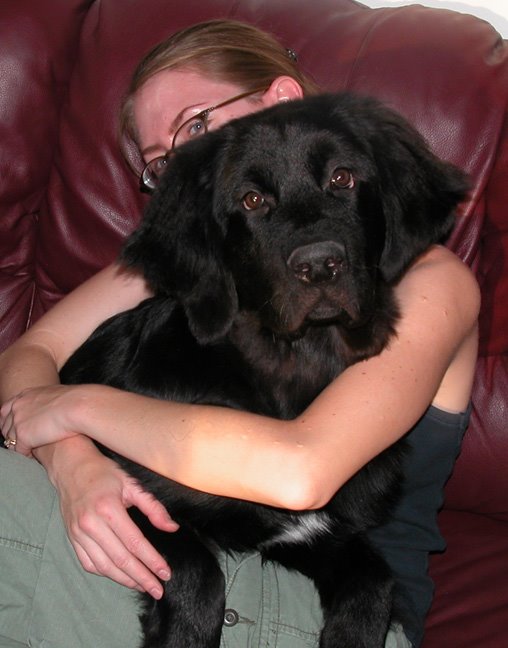
Katy now weighs about 80 pounds at seven months old and is still up to her old ankle shark tricks. She has what we've affectionately started calling 'nonregulation Newfy ears.' They're really long and her adult coat hasn't fully grown in yet, so she's got a bit of a mad bomber hat look about her which is made ever so endearing when she just wakes up and strolls in to say hello, face pointed at the floor, ear flaps flopping.

Besides being the Baroness von Roughenhausen, she's also known around here as the Mad Bomber.

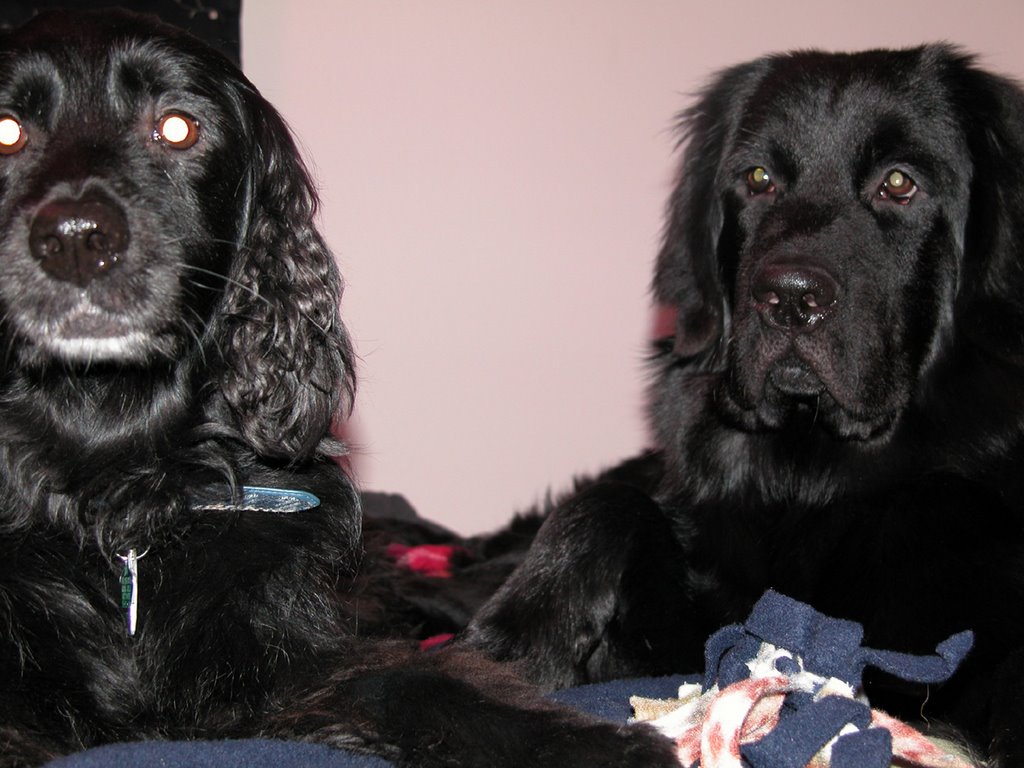
She still likes to pounce on Max, intimidate him into dropping his bone, and run him off the road so to speak. She likes him though and when she lingers around outside longer than I'd like to, all it takes to get her excited about going back inside is a quick "Wanna go find Max?"

She invites him to play constantly but he always turns her down. She has to settle for his snarling versions of play.

She loves to lick the inside of his ears. Ewww gross. At least someone else is cleaning them these days! It's as affectionate as they get... except for the times we come home and find them sleeping on the couch together.

We take her down to campus to let her run off some steam off the leash on Ankeny Field. She loves to play chase and fake-tackle. She still gets really hyper at least once everyday at home. She tears ass around the house, running a circuit from the front to back as fast as she can go, sometimes running a figure eight around some barrier. When she's done I have to go around and straighten out the rugs. We can always tell if she's had one of these hyper fits while we've been gone because the rugs are out of whack.

She is fascinated by the shower. Whenever I get one started she pokes her head in to take a drink. Sometimes I form a little cup with my hands to assist her gulping. She comes in to visit every so often during my showers too. To rewet her head? Check on my progress? See if I need a rescue? Newfoundlands were bred to be water rescue dogs afterall. One time while I was shaving my legs she poked her head in and licked my butt. I had no idea that was coming, but now I know not to turn my back on the curtain! There could be a Newfy tongue waiting to ambush me. I think she just likes to get her head wet. Once her ears dry out she looks like she's just visited the bedroom beauty salon of a thirteen year old girl in the 80s, major crimping action!

I'd love to see her swim with Alasdair. That would be an absolute riot.

This morning she had a decidedly non-Newfy day. She refused to go out in the rain. WTF? It was really bizarre. I expect that from Max but not her. Maybe she's feeling a little off given her bladder infection. We noticed her 'urinary incontinence' problem over the weekend. She got to spend a night at the vet and came home with not one but two bottles of Cephalexin because of her S.I.Z.E. I guess she really is big. She's still very much a puppy though.

She learns quickly and has mastered SIT, LIE DOWN, COME, GIVE and all of the accompanying had signals. We need to work on stay. I suppose she could learn a few more tricks too. She knows shake. We haven't taught her roll over or circling yet. They seem kind of boring because Max does them with such gusto. Any ideas for cool tricks to teach a smart dog? I suppose we could teach her to speak on command. Max doesn't vocalize enough for us to have taught him that, but Katy has a whole range of things she 'says.' Her bark is serious and sounds like something a bloodhound or basset would produce. She also gives a hilarious yowl-moan when she flops down.

She's a wonderful dog. We've had yet another Hug Your Newfy Day today.

And, she is much prettier than the Newfoundlands featured in the calendar that arrived today courtesy of my dad.

Wednesday, October 18, 2006

Hardly A Day Goes By

Yesterday my dear sweet Man With Fins told me a hilarious story about someone who proposed to write a science column for the local newspaper that he edits. The lead for one of the columns read "Hardly a day goes by without thinking about DNA..."

I doubt that's true even for geneticists, so we collectively laughed uproariously.

Ironically, today I realized that I really had been thinking about DNA for the last couple of days because of a short article I read in The Economist about epigenetic imprinting. In short, mice that are licked and groomed by their mothers early in life grow up to handle stress better because that early experience adds a little chemical to a portion of their DNA which then changes the way that gene works. So, you could have identical genes expressed differently in two different people because they have different life experiences. The article paints a much more interesting picture of this. I certainly recommend reading it!

Among other things, epigenetic imprinting has been hypothesized to play a role in cancer and mental illness.

October is Breast Cancer Awareness month. This morning I heard a statistic that 90% of women who get breast cancer have no family history of it. I've also heard that aluminum in anti-perspirant has been linked to breast cancer, BUT did you know that epigentic imprinting may play a role in breast cancer and your weight at birth might be a risk factor?

A paper released this month in the International Journal of Cancer proposes that premenopausal breast cancer may originate in utero. That's right ladies - before you were even born your cells might have been marked. A higher weight at birth increases a girl's chances of getting breast cancer. "Loss of imprinting of growth hormone genes relevant for intrauterine growth, such as insulin-like growth factor 2 (IGF2), leads to abnormally high levels of these hormones evidenced by high birthweight," the study says.

I wonder how gestational diabetes plays into this. Women with gestational diabetes are at risk for having a baby that grows too large. Perhaps too much glucose causes the baby's genes to fail to turn off the growth factor?

I drink a lot of soy milk so I read this other abstract that says agoutis (cute rodents that can be seen in Belize and Guatemala where I saw them) not only change their hair color in response to ingesting phytoestrogen that is present in soy, but also receive protection from developing obesity by, you guessed it, the way the phytoestrogen changes how their DNA gets expressed. What's also interesting is that they say phytoestrogen is linked to "diminished female reproductive performance." Does that mean I harm my fertility by drinking soymilk?

More interesting genomic imprinting information can be found at geneimprint, a site set up by Randy Jirtle, an epigeneticist.

Friday, October 13, 2006

An Island of Colorblindness

I don't spend much time thinking about what life would be like if I couldn't see the difference between cyan, turquoise, indigo, cerulean, and azure or even between red and green, but after watching Oliver Sacks documentary "An Island of Colorblindness" I have a whole new appreciation for being a trichromat. The documentary chronicles the rare condition of achromatopsia that affects many of the residents of Pingelap, an atoll in the South Pacific. People with the condition see entirely in shades of gray.


Achromatopsia is caused by a genetic mutation that results in the complete or partial absence of cones, the retinal cells that translate photons of light into color with a bit of help from the brain. Light doesn't have any color to it all; color is a construction of our visual system. For the people with achromatopsia on Pingelap, vision that is dominated by rods instead of cones presents its own set of challenges. They have poor visual acuity and sunlight is very painful. They look down virtually all of the time during the day, squint, and blink a lot.

Now that sort of photophobia was actually something I could empathize with; I've experienced that fairly often and acutely so after a brush with something called microcystic edema. I had extreme sensitivity to light, couldn't see to read unless I held the pages about 5 inches from my face, and saw huge rainbow halo around lights. It was awful - there was no treatment, no correction for my vision available - but fortunately it cleared up on its own and hasn't appeared since. Phew. I also stopped wearing contact lenses.

That's probably the last time I thought seriously about vision until I took a graduate level class on vision. I've thought about it a lot since then too. As a psychology professor it's an occupational requirement. And as a primatologist I've read a paper or two about the evolution of color vision among primates. Some species of monkeys are dichromats - they have only two kinds of cones and see much like what most people think of when the term colorblind comes up. Scientists believe the ability to distinguish red from green helped newly evolving diurnal monkeys spot edible leaves and fruit better in the daytime. Previously, monkeys had been nocturnal and ate insects and tree sap. Monkeys who could distinguish colors in the daytime could exploit new niches. They thrived. As a dabbler in art, I appreciate matching and mixing colors for the most pleasing aesthetic effect. But, I take for granted the ability to actually see in color.

Los colores son mi vida is the motto of my impressively talented and successful mother-in-law who weaves multi-colored palettes of yarn into beautiful fabrics. My husband weaves too. They have an entire vocabulary of color terms that never fails to impress me when I eavesdrop on their plans for "warping the loom." I might look at a selection of threads and call them purple while they toss around terms like plum, violet, lavender, eggplant and more. While watching the story of the Pingelapese I was struck by how totally unnecessary such an advanced linguistic library would be for them.