Showing posts with label developmental psychology. Show all posts

Saturday, April 24, 2010

A Huge Week: Developmental Milestones Galore

Phew! What a week. Baby Field Notes must have finally flipped whatever switch gets flipped when a whole new cognitive system comes online. All in the last week we saw some big developmental milestones.

It started with sitting herself up from lying down on her back and then later that afternoon I felt her first sharp tooth emerging from her gums. The next day she took her first steps while holding onto my hands. Previously she only 'walked' by me moving her legs for her. She seemed to like the sensation and accomplishment of moving forward in spite of the great physical exertion. Physical therapy is hard work! But no way did expect that in just days she would be stepping forward on her own. The first time she bent her knee, lifted her foot up and set it down in front of her I was surprised. I thought it was just a fluke, like the day she said BIG, but then she did it over and over again, for twenty feet! And then she kept stepping — more that night — and has been doing it ever since.

And then just today she clapped her hands together. When I noticed I exclaimed to Mr. Field Notes who told me she had actually done that yesterday while we were all out on a stroller walk. Yesterday. It has been very exciting around here the last several days!

It is amazing to me both how slowly — and how quickly — human development progresses. Being a primatologist, I am anxiously awaiting her first attempt at grooming. That will be super exciting. No one, as far as I know, has cared to note when that starts happening for humans, and it's not something I've looked into much for other primates, but I do recall somewhere that either Jane Goodall or Anne Pusey has noted when young chimpanzees first start to groom others. I see signs that Baby Field Notes is getting ready to groom. She notices smaller bits of stuff on the floor and has the fine motor skills now to pick up small things, like a tiny leaf, for example, so I know physically she could do it, but I am not sure she yet has the cognitive capacity to intentionally 'clean' something.

Her babbles are getting more prolific now too:
n-n-n-nay
mmmmmm
g-g-g
th-th-thuh
b-b-bah
puh-puh-puh-up
d-d-d-dah-dad

We've heard some ma-mas and some da-das but not for the specific parent. I half expect her to say Yuki or Katy before Mommy, honestly. Those dogs continue to entertain her, and her them. Yuki, the slightly smaller, younger Newf is her BFF. Katy is interesting too, but not nearly, and I think isn't nearly so because she is more stand-offish. Big K is just harder to get to know!

Monday, March 29, 2010

We have a talking ape now! Baby's First 'Real" Word

Today Baby Field Notes said her first 'real' word: UP.

Previously she has said 'BIG,' which blew me away because, a) she's a very quiet child who doesn't really babble on and on so we've rarely heard vowel and and even fewer consonant sounds, b) was late to giggle, c) was only about 8 months old, and d) perfectly enunciated the word: BIG. It really surprised me. She's certainly heard that word a lot, what with two enormous dogs keeping her company!

This time was different though, because she used UP in the right context, intentionally, and along with the right gesture. When she said BIG it probably was unintentional. I think she was just experimenting with her tongue and mouth and voice. It wasn't in the right situation, at least not without making up a story, and wasn't coincident with any meaningful gesture, so it really can't be considered language.

But what is language? It's complicated but you can glean a lot from this excellent discussion, if you click here.

Tuesday, November 17, 2009

Check out all the monkeys! .... And a word on BPA and behavior


Just about every day I check the snow monkey web cam at the Jigokudani Monkey Park in Japan. I've been doing it since we came back from Japan nearly a year ago. I've enjoyed seeing the changing of seasons and the comings and goings of tourists. This snapshot is remarkable for the numbers of monkeys hanging out at the hotsprings and the complete absence of tourists. The day we visited there were easily five times as many tourists as monkeys. I had a good time but it would have been way more awesome to have them all to ourselves!

The Arashiyama monkey park right outside Kyoto is far more accesible than Jigokudani and even though a similar number of tourists frequent it, the place is bigger and everyone is able to spread out more. People are also allowed to feed the monkeys at Arashiyama from inside a cage (the people are in the cage) which makes for a fun experience — at least it was for me. I had a blat hand feeding itsy bitsy pieces of apple to the babies and also observing a bit of a sense of entitlement on the part of older monkeys who displayed a considerable amount of disdain for such stingy handouts. If I offered a piece of apple that wasn't large enough, one monkey slapped it away, more than once (so I knew it wasn't an accident). He or she readily accepted larger chunks. Spoiled much?

So, monkeys are a curious bunch, and they've been on my mind again lately on account of some research that's started to make the rounds of news sites. It's on BPA — the chemical added to plastics to make them hard and is now known to pose health risks. Well, it also apparently feminizes male behavior in monkeys. The dangers appear to be most linked to prenatal exposure. In monkeys, research published this year in the journal Psychoneuroendocrinology shows that prenatal exposure of monkeys to BPA causes male monkeys to cling less to their mothers and look away more while clinging. Supposedly this is more typical of female infants in the species of monkey studied (long-tailed macaques, a close relative of rhesus macaques).

Chemicals added to plastics to make them softer are also blamed for feminizing behavior — and this time the research comes from humans. It's not experimental data, but pilot research published in the International Journal of Andrology shows that preschool-aged boys with more exposure to phthalates in utero were less likely to engage in stereotypical boyish play, specifically play fighting and playing with trucks and guns.

Sunday, October 11, 2009

Infant Handedness: Baby Field Notes a Lefty?

A greater preponderance of left-handed U.S. Presidents aside, it has me concerned, a little, that Baby Field Notes might turn out to be a lefty. She's showing what I would call a strong preference for sucking her left hand, moving her left hand more, and holding things longer with her left hand.

The first question I had was whether there's any research to suggest that early hand preference correlates with handedness later. I'm still doing the research, but so far I've turned up some interesting stuff, all published in reputable journals like Developmental Psychobiology and the International Journal of Primatology.

Handedness is associated with brain lateralization and specialization, meaning that the two hemispheres are not exactly alike. The right and left hemispheres execute different functions. For example, most people process language in their left hemispheres. Spatial reasoning, such as mental rotation of objects, is processed in the right hemisphere. Although it's not a perfect relationship, the vast majority of right-handers (90%) process language in their left hemispheres, but only about 70% of left-handers do. A higher proportion of left-handed people process language in the wrong hemisphere, or both hemispheres. It's also said that they are more likely to be dyslexic.

Nonhuman primates are generally not thought to have much language capacity (there are exceptions!). They are also thought to not show much evidence of brain laterality, i.e. their cerebral hemispheres are more symmetrical in function and do not show a left hemisphere specialization for language (there are exceptions!). Furthermore, they are not thought to show a hand preference, i.e. they don't preferentially grasp or manipulate stuff their right hands (there are exceptions with this too!).

What all this means is that other apes don't have the amazing language abilities that humans have because they don't have the brain circuitry specialized for such a complex task and their lack of hand preference is one piece of evidence for that. However, I think that there is plenty of evidence that other apes have some language capacity and that it's likely early human ancestors (6 million years ago) also had language capacity. The human ability to write and recite nursery rhymes didn't just appear out of nowhere, it built upon earlier capabilities.

Left-hand preference may be just one symptom of something gone haywire in brain circuitry regarding language development given the links between the hemisphere dominance, handedness and language processing. In other words, it's not too surprising that more lefties would have language difficulties and I hope that Baby Field Notes doesn't! Language stuff aside, it would make life a lot easier for her to not have to deal with the hassles that lefties encounter.

A good example would be the rotary paper cutter we have. It, like the vast majority of paper cutters, is set up for right handers. The blade is on the right side and the grid and platform to rest the paper on is to the left. For a left handed person to use it, they would have to either operate the blade with their clumsier hand, or, they'd have to hold the paper with their right hand and reach across their right wrist and hand to grasp the arm or blade to cut the paper with their left hand — a recipe ripe for making a mistake and winding up injured.

Speaking of language I find it interesting that the word dexterous, meaning nimble or skillful, comes from the word dexter, which means right. The dexter hand is the right hand. In contrast, left in French is gauche, which in English means clumsy or boorish. Compliments that have a subversive, not so nice element to them are left-handed compliments. I'm just saying, left handers don't just die earlier (as research has found), our whole language schema paints them in a poor light.

However, left handedness/right brain dominance is also associated with being gifted analytically, particularly in mental rotation and three-dimensional problem solving.

In an effort to find out whether early left hand preference is associated with being a lefty, I skimmed a bunch of journal abstracts, and although I haven't yet found an answer, I did learn some other interesting stuff.

At just 5 months gestation, fetuses already show brain lateralization. Using ultrasound imaging, researchers measured the size of both lobes of the brain of around 100 fetuses and found that their left hemispheres were larger than their right hemispheres. Also interesting is that the girls had larger brains.

Fetuses suck their thumbs in utero, no surprise there, but they also show a preference for sucking their right thumb and this can show up as early as 15 weeks of gestation. Also, research on some primate species, including both monkeys and two kinds of apes (bonobos and chimps) has found that they have a nipple preference — left — which is also associated with a preference for turning their heads to the right, which would be toward the left breast when being carried and while suckling. What's noteworthy too, is that nonhuman primates and humans both show a bias for left-handed infant carrying and cradling.

Early on, BFN preferred the right boob, the atypical pattern. I also have a strong preference for carrying her and cradling her in my right arm. Mr. Field Notes does it in the more usual primate fashion — with his left arm — and was the first to observe that I don't. So I guess I am odd and maybe Baby FN is too.

In any case, Baby Field Notes may indeed turn out to be a lefty, and it's not likely I will be able to change that if she is. Handedness is not learned, a plethora of research suggests. Instead, it is "a spontaneous expression of the developing nervous system unaffected by the environment," as Dr. Johanna de Vries put it best.

However, other researchers, such as William Hopkins, point out that behavior can influence brain development, so use of the right hand can theoretically cause the brain to develop asymmetrically. [I think there's some merit to that, but how likely is the preference of right hand use to be just chance?] I think it's more likely hand preference is genetically determined and there's a good chance that no amount of me putting things in Baby Field Notes right hand will change anything if she is indeed a lefty.

My intuition is also that she is likely to be a lefty, given her hand preference now.

Thursday, October 01, 2009

Don't talk to your baby! Blackberry instead.

She's just a little monkey at this point anyway.

The guilt trips that new mothers give themselves for not talking or playing enough with their infants is ridiculous — an unwarranted. Take for instance a mother of a 2 month old I know who put a sign up over her TV reminding her to talk to her daughter instead of watching TV while she breastfeeds her. Today I was reminded of this while reading a New York Times opinion piece, 'From Birth, Engage Your Child With Talk,' on my iPhone while sitting next to my baby, who was alas, not asleep. While I could have spent the entire time talking to her while I was in the car waiting for Mr. Field Notes to return with a new supply of bulk nuts from the grocery store, I instead chose to read news on my NYT's iPhone app. I admit, I felt a twinge of guilt, but it quickly dissipated.

A 2-month-old is developmentally incapable of attaching meaning to what you say; it's far more important to just interact, which you can certainly do when your baby is in the mood. Babies don't always want to interact with their parents, and they definitely let you know when they are interested. The first sign is that they return or hold eye contact. Sometimes they just want to observe stimuli around them and sad to say it, but your face isn't always the most interesting thing in the room and certainly isn't when you're breastfeeding — then it is 99% about the boob.

When not eating, Baby Field Notes finds the overhead fan appealing. The dark blades stand out in stark contrast to the white ceiling. Ditto for the shelves on the wall. She will look at them, relaxed and attentive, after she's eaten, that is if she's still awake. I rarely talk to her while I feed her. She can't respond back anyways. Bonding over a meal while talking is something reserved for a later developmental stage. There's time enough to talk during other activities (like during diaper changes), so I say, go ahead and Blackberry or iPhone or text or do whatever you do while breastfeeding baby and don't feel guilty about it.

I don't spend much time 'talking' to Baby Field Notes and when do, I often make the sounds an ape would make to her infant — soft oooohs and aaaahs, some high pitched squeals and staccato giggle grunts too — because those are the sounds she responds to. I don't think that's an accident. At this stage, she really is more simian than human. I do speak to her, but I don't always enunciate, e.g. "I wub you," and I don't always use perfect grammer, e.g. "Oh, you so cute, cute, cute, so cute you!" As long as they are exposed to language during the critical period from birth to age 7 or so, children can speak and can acquire perfect grammar and syntax — the hallmarks of language. In fact, studies have shown that this "motherese" language pattern of using short, simplified sentences, repeating words often, and using high pitched intonation is a human universal, probably because it helps in language acquisition.

For some evidence that infants are more simian than human at this early stage of development, one need only look at the shape of their vocal tracts. Apes and adult humans have a noticeably different layout of the larynx (voice box), pharynx (throat) and tongue, as you can see in the diagram that I colored so you can more easily make them out. Compared to other apes, humans have an elongated pharynx (red) and a lower larynx (purple) that is situated below rather than behind the tongue (pink). The image to the right shows the layout of a human infant's vocal tract. You can see that it more closely resembles the nonhuman ape anatomy. As an infant matures, these parts shift toward their final, adult human form — and with it, the ability to make the full range of human sounds. Similar structural changes occur in the infant's developing brain. As the infant's tongue develops more coordination and control, so too do parts of the infant's brain related to speech.

At the tender age of 2 months and for several months more, babies can't understand speech, let alone what the heck you're carrying on about when you name all the random stuff in your field of view (as the woman in the NYT article did). Babies can only judge whether or not you respond in a timely and appropriate fashion to their calls for help — so go ahead and take care of that email, get caught up on those TV shows you enjoy, read that magazine article — and tend to that crying baby by feeding her when she's hungry, changing her diaper when it's wet and saying silly things to make her smile when she's bored. There will be plenty of time later for conversations.

Monday, September 07, 2009

Primate Parenting - A Stark Difference?


When I saw this product, the BéBé Bottle Sling, at first I thought, hey cute! Monkeys! Then I thought, hold up a sec — that is weird and maybe a little wrong.

The bottle sling hangs from the handle of an infant carrier or car seat and positions the bottle right on front of the babies face. Babies learn coordination and figure out on there own how to take the bottle into their mouth and drink when they want. After they're done, the bottle returns to a spot right in front of the baby's face. It permits hands-free bottle feeding.

Cool concept.

I thought I could make one of those, how hard could it be? But then I realized, perhaps wanting to save myself from yet another project or perhaps recalling all of my many childhood pet hamsters, that this is like sticking your kid in a cage and hanging a bottle inside so they can drink/eat. A flash of a baby in a wire cage with cedar chips, running wheel and a bottle full of milk mounted to the side of the cage briefly flashed in my mind.

While I think this product is potentially interesting, and useful, it also highlights a major difference between nonhuman primates and human ones, especially those in western, industrialized countries anyway.

Nonhuman primates (most often moms but there are plenty of exceptions) have their babies with them all of the time, even at night, often in full body contact. Not until the babies are old enough to crawl on their own are they away from mom and even then they stay within arms reach. Ape babies can be in full contact with their moms for 3-4 years on average, nursing on demand the entire time, even at night while mom sleeps.

But human babies, especially those in the US, get bundled up in infant carriers, motorized swinging chairs, strollers and cribs in separate rooms starting in their first days of life.

I wonder what effect all of this 'baby parking' has on human attachment — the affectionate social bonds shared between baby and parent, and later between romantic partners. After all, it has been shown that it's a warm, responsive caregiver to cling to that young primates need for normal social development.

When that soft, warm, responsive body is taken out of the equation and replaced with a cold, hard nipple hitting you in the face, how can you possibly develop normally?

When primatologists who study parenting point out the stark difference between nonhuman and (Western) human parenting, they rarely come right out and say what effect this lack of constant body contact has on us as a species. Does it make us more prone to be solitary jerks as adults? Is that why we needed to invent stuff like religion to remind us to be kind?

I don't know what the answer is, but it is reasonable to ask.

Now, really, an argument can be made that this product allows a more natural approach to feeding if you're using a bottle. When nonhuman primates feed, they can cling to mom by themselves, riding along and nursing while she forages. Her nipples hang down and baby can latch on and drink whenever. The only real significant difference between this and and the BéBé bottle sling is the nipple and the temperature of the milk.

As long as baby gets interaction at other times, as most babies would, this product could come in very handy. I just can't envision myself using it, but they ..almost.. got me with that darling monkey design.

Wednesday, July 22, 2009

Vestigial Characteristics: Monkey Features of the Human Newborn

Newborn babies arrive with some pre-installed software and hardware that demonstrates, beyond a shadow of a doubt, our primate heritage.

Vestigial features like Darwin's point (see post below) evoke the pointed ears of Old World Monkeys — the ancestral line of nonhuman primates from which human primates descended. Old World Monkeys have pointy, Spock-like ears. You can see them perfectly in the photo of the baby saki monkey at the right.

The ears of Baby Field Notes have this point, named after Darwin because he was the first to observe and write about it. The arrow in the photo shows where she also has a tuft of hair growing from her ears. Right now the hairs are about 1/2 centimeter long. Like the hair growing on her shoulders, this hair will thin out with age.

Perhaps you can feel a small bump along the rim of your ear. Feel along. Not everyone has one that is pronounced and if so, it is often only present on one side. That little bump is a relic of your ancestors' descent from monkeys. So is the shoulder hair and ear hair of the newborn human primate.

In fact, humans are just as hairy as other primates, including other apes. We have just as many hairs per square inch as chimps, gorillas, bonobos and orangutans. Ours are just so fine and so short that they appear to be invisible, thus giving humans their 'naked ape' label. We're not really naked and hairless at all. Look closely at your skin under good lighting the next time you get out of the shower and you'll see what I mean. Our faces are hairy too.

As for pre-installed software, newborns have a number of reflexes that would clearly have been evolutionarily advantageous. One, the Palmer grasp, wold have been useful for grasping onto mom's hair in an emergency if she had to move abruptly. Newborns can actually support their own weight with it. I am not willing to experiment with BFN, but you can see in the following video exactly how impressive this reflex is.

Palmer Grasp Reflex


The Palmer grasp can be seen in human newborn feet as well.


The Moro reflex is another reflex useful for keeping baby with mom when she moves. Other primates occasionally hold their babies when they move, but for the most part, nonhuman primate babies latch onto mom's hair on their own and can stay in contact with her while she moves even when mom doesn't provide support. Humans retain these reflexes in spite of not being able to take advantage of them. They are atavistic, vestigial traits. These reflexes, like the presence of a nonfunctional appendix, illustrate that not every trait that is a product of evolution has a function in its present form.

Moro reflex

Monday, June 15, 2009

Baby Birth Announcement: It's a Gorilla!

(Credit: San Francisco Zoo)

A baby gorilla who was born 6 months ago at the San Francisco Zoo has started making some appearances now that he's old enough.

He is way too cute. I don't think there's anything in the world cuter than a baby gorilla, that's my bias. Maybe my own little baby 'gorilla' will be cuter, but I doubt it. Is that mean? What can I say, I am biased I admit it: I love baby gorillas.

As with most zoo birth stories, this little bugger was rejected by his birth mama but another female stepped in to care for him. She carries him on her back in the customary "jockey style" position. The babies ride face-forward sometimes, other times facing the reverse direction. Whatever feels good and works. Having hair makes it easy to hang on to mom, giving her the ability to move around more or less unencumbered, unlike human moms who must use at least one arm to support a baby she carries.

Even though human ancestors lost their hair a long time ago, for whatever reason — it's still a mystery even though there are some interesting theories — human babies have retained the moro reflex.

Babies up to around age 4-5 months, in response to being startled by a loud noise or falling sensation, will extend their legs and arms with hands open then bring them back to their body with their fists clenched.

It's an obvious safety mechanism left over from the days when that sort of automatic response would have helped the baby grab mom's hair in an emergency - having to quickly flee a spot, nearly falling out of a night nest up in the trees, etc. I don't know for sure since no one really makes a big deal of studying such obvious things, but I'd bet all primates have this reflex as newborns.

The absence of it in humans, or presence of it but only involving one side of the body, is a sure indicator of neurological problems.

There are lots of other cool reflexes babies have only during their first few months of life. I'm looking forward to seeing them.

And, yes, I am a little envious of the whole gorilla-baby-can-hang-on-to-mom-but-human-baby-can't thing. It means I'll have to find a sling to wear if I want to have both hands free. Ideally, I'd have one I could use to nurse hand's free. Gorillas don't have to wear diapers either...
I'm just saying. Not really looking forward to that end of things. But, I have smelled gorillas, and as much as I love them, holy man alive - they freaking reek!

Let's just say they have a distinctive odor. But they are still the cutest little beings on the planet. Little Hasani, whose name means 'Handsome,' even has a baby registry at the zoo in case you want to send him stuff.

You've got to see the video of him with his surrogate mama for the first time. You can see her playing the airplane game with him - putting him up in the air with her feet and hands while she lies on her back. Chimps do this with their babies too. It aids motor development. There's a lot of continuity among species in early primate development.

Mama Gorilla Plays Airplane Game With Baby Gorilla

Saturday, April 04, 2009

Is autism caused by vaccines? The straight truth.

More and more these days I notice parents who refuse to have their children vaccinated for measles, mumps and rubella because they have heard that the vaccine causes autism. They are all shockingly uninformed, but don't realize it. Part of the problem lies in the fact that they don't realize the one bit of highly publicized research evidence that supports the autism link is riddled with multiple and damning problems. And just this week, it got a lot, lot worse.

According to an investigation by the Sunday Times newspaper, the doctor who sparked the scare over the safety of the MMR vaccine, Andrew Wakefield, fabricated the data that created the appearance of a possible link with autism. He lied. You can read the full article here.

Compared to lying, the other problems with Wakefield's research seem minor in comparison. But nevertheless, even if the results were not made up, the fake-o numbers still do not in any way warrant the autism hysteria that has erupted over vaccines.

And the effect of the hysteria is significant. After the publication of Wakefield's research in 1998, rates of vaccination fell from 92% to below 80% in the UK, according to the Times. And in just ten years, the number of confirmed cases of measles skyrocketed to 1,348 compared with just 56 in 1998.

Aside from the glaring problem with using fabricated data, the other problems with Wakefield's research are threefold, scratch that fourfold!

1. extremely small sample size: The research included only 12 kids!

2. relied on retrospective evidence: Rather than starting out with a sample of children who neither had autism nor had yet been vaccinated, the study used parents who reported autism symptoms after the child was vaccinated. In other words, the researchers relied on parents of autistic children’s memories of events — parents who were understandably upset and far from objective observers.

3. biased sample, i.e. not randomly selected: Almost half of the kids' parents were recruited by a lawyer who planned to sue the vaccine manufacturers. Even Wakefield himself received money to assist the case by finding scientific evidence of the link between autism and the vaccine. You can read more about that here.

4. conclusions overstated the data: The published article stopped short of concluding that there was a causal link between the MMR vaccine and autism. However, when Wakefield spoke to the press he made no such disclaimer. And to this day, outspoken celebrities jump on the bandwagon.

One reason some parents think vaccines caused their child's autism is the timing of diagnosis. The first signs of autism don't appear until around 18 months to 2 years of age, the same time period in which kids are vaccinated. It is this unfortunate timing that makes parents think the vaccines caused the condition. Another case of erroneous correlation = causation thinking.

If vaccines really were causing autism, you'd at least expect to see the incidence of autism rise and fall with the rise and fall of vaccination rates — but it doesn't. You can read the published research yourself here. The article also has an impressive list of other relevant research articles on the subject. I think it's pretty much overwhelming evidence that something other than vaccines causes autism.

Thursday, March 05, 2009

The Price of Walking Upright

Oh to be a monkey in about 4 months instead of human... things would be so much easier, specifically giving birth.

Labor and delivery is not something I used to think a lot about, outside of the day I spend with my primate behavior classes talking about it.
We discuss the impact of skeletal and pelvic bone arrangement on labor and delivery in my unit on bipedalism. They are often amazed when I tell them other primates give birth in about 30 minutes.

Walking upright is a major adaptation on the part of humankind so it's only fitting to devote a good amount of discussion to it. I think it's a really fascinating
subject, not just because the transition from 'knuckle walking' to walking on two feet required major changes to the arrangement of bones that made human childbirth incredibly dangerous — and painful — but also because no one yet has any convincing and widely accepted explanation for what drove the shift to bipedalism in the first place.

Was it that our hands we free to carry food, tool
s, a baby? Who knows. Some think we stood up because it kept our bodies cooler while walking long distances in the African savanna to find food. There are at least 6 other unique theories out there and whatever the explanation — the cost is significant.

The human pelvis became shorter and broader and the opening in the bones, the birth canal through which a baby passes during delivery, took on a more oval shape. The fossil, Lucy, one of the first skeletons to show signs of upright walking, resembles a modern human pelvis more than a chimpanzee's. The shift meant that babies, including ancestral humans, had to turn sideways during delivery rather than coming straight out like other primates.

When other primates give birth, the babies come out face up, more or less looking right at mom. Mom can see the baby the whole time and guide the little guy out all on her own. Not so for humans. If a human mom were to try to pull her baby out on her own, the angle of the head and neck would be off enough to potentially break. The shape of the human pelvis is great for walking, but very bad for solo delivery. It's believed that humans have always had to have a helper during delivery.

Another unique development that made birth difficult for humans is our large brain. Psychologists and evolutionary anthropologists call this 'encephalization.' Based on fossilized skull remains, our craniums and brains appeared to get significantly larger right around the same time we started walking on two feet.

In most cases, the baby's head is larger than the birth canal and without flexibility, the baby couldn't be delivered successfully, and either baby or mom — or both — would die. Even now with modern medical approaches to childbirth, a significant proportion of babies are delivered surgically through C-sections because the baby's head is too large.

Without some modification through evolutionary processes the human species, with it's unique gait, would have gone extinct. Two adaptations worked against this:
  • relaxation of ligaments that hold together bones of the pelvis, hips and back
  • gaps in the baby's skull
Both ultimately helped make birthing big brains possible. The 16-30 hours of labor are just one cost. In contrast, other monkeys (with a few notable exceptions) and apes give birth in about 30 minutes!


Although that may sound idyllic, it's not something I or any other pregnant woman is ever going to experience. But we can be very thankful that human birth and labor is not nearly, not even remotely as awful as what female hyenas endure. More on them next time... It will blow your mind!

Friday, February 20, 2009

'Little Baby Thumpins'

You wouldn't think that reading Developmental Psychobiology journals on a Friday night was at all fun, but I love that stuff! What can I say, I am a nerd. I read college level astronomy textbooks when I was in 6th grade. That probably makes me a dork, but I don't care. Knowledge is thrilling. Science is thrilling.

My reading was sparked by a question I had, based on an observation and a hypothesis. See, my developing baby is now kicking. Even Mr. Field Notes can feel it. Most first-timers can't detect the baby's movements this early so I chalk it up to being highly observant. The kicking got me wondering if babies who move and kick a lot grow up to have highly active personalities. Do they grow up to be more extraverted and bold? That's the question I had in mind when I started my mini lit review.

All good literature reviews begin with knowing which key words to search for. I think a lot of students have trouble at this stage, which makes sense. They don't yet have the jargon of the field down enough to know which terms will quickly get them the relevant research. I also think they don't realize that they don't know which terms to search for and don't ask for help early enough so they waste time searching around for stuff like "baby personality development" and maybe adding in something like "movement during pregnancy" when a simple "fetal movement infant temperament" would return the landmark research right away.

In psychology, temperament is the key word. It's like personality — in the sense that it refers to an individual's pattern of behavior and emotional states (level of arousal, motivation, mood) that are apparent and stable over time. But — it's a little different in the sense that temperament typically only refers to what is seen in infants and it's more often thought of as genetically based, if not nearly completely genetically determined.

Temperament varies from individual to individual. Babies may have the same level of motor development and ability level but differ in their mood (calm to irritable), how distractable they are and their ability to adapt to changes. These patterns are believed to be dependent on inherited physiology — concentration of neurotransmitters like dopamine, serotonin and epinephrine as well as density of receptors on the brain's neurons for those neurotransmitters. They form a biological basis for personality development.

I would go so far as to say that all animals have a temperament. Even some paramecium are more active and mobile than others. Behavioral differences are one of the variables that make evolution possible. These difference fall into three broad areas:
  • Emotionality: calm vs. irritable, easy vs. difficult to soothe during distress, frequency of crying and tantrums
  • Activity: lethargic vs. energetic
  • Sociability: reclusive vs. social, prefers to be alone vs. with others
Katy and Yuki, the lovable Newfoundlands that grace these pages now and then, have remarkably different temperaments. Katy is incredibly difficult to soothe if she's upset and is a bit of a loner. Yuki on the other hand, calms down easily and strongly prefers to be with others. These two are very different in temperament in spite of growing up on the same farm, with the same family and having the same biological parents. I suppose Forrest Gump would now say something like: DNA is like a box of chocolates. You never know what you're gonna get!

But, I sure would like to be able to predict whether Baby Field Notes is going to be hell on wheels or a relatively easy baby. I thought perhaps fetal movement would be associated in some way with later temperament.

These are precisely the kind of thoughts that lead scientists into new avenues of research or at least a decent start at a thesis or dissertation topic. My brief review of the literature suggests there's no need for me to embark on a new field of research — it's actually already been done before and the question is answered.** It turns out there is evidence that the roots of temperament begin during the prenatal period and can be observed in fetal movements. Cool beans!

More fetal movement is associated with being easier to calm but also to being more active, and perhaps hyperactive. I can handle that. But, I still don't know whether 'Little Baby Thumpins' kicks any more or less than other developing fetuses. I guess I get what I get! I'm excited either way, but I really would love love love to have an "easy" baby. Mine just seems to kick and squirm an awful lot!

DiPietro et al., Child Development, 67(5):2568-2583, 1996

Friday, December 28, 2007

Harry Harlow & the Science of Anxious Attachment

One of my very favorite days in introductory psychology is the day we talk about developmental psychology and attachment. Why? I get to talk about monkeys and Harry Harlow.

As a scientist and a person, he is as interesting as his famous research on cloth vs wire surrogate mothers. The book Love at Goon Park: Harry Harlow and the Science of Affection provides a good summary of attachment research at a level that is easy to understand. It also presents numerous stories about Harry the person. Did you know he wrote poetry? Yep - that's how he took notes for his exams as an undergraduate student! One of his famous papers, The Nature of Love, published in 1958, includes one of his poems. The man may have done some arguably cruel things to the cute little monkeys in the name of science, but he was not a heartless bastard, as some people would have you believe. Both the book and the Nature of Love article are well worth reading. If you click on the Nature of Love link, you get taken to the entire article, poetry included.

His research sparked the science of affection, and if someone had asked me at any point during my graduate career to name the progenitor of my field, I would have been hard pressed to come up with a more appropriate person.

It's crazy how fascinated research academics are with genealogy, but they all want to know who your advisor is, and who they studied under and who they studied under so on all the way back presumably to Wilhelm Wundt. Some university psychologists take great pride in being able to trace their lineage back to the big wigs. I wonder if it's just a psychology thing or endemic to academia.

Academic heritage aside, back in the "good old days," when people thought mothers caused their children to be autistic through improper mothering, Harlow set out to study affection - specifically LOVE. Apparently what sparked his big idea was an observation that monkeys screamed and threw tantrums when the cheesecloths lining their cages were removed for cage cleanings.

Ever try to take a child's favorite teddy away to give it a little cleaning? You'd start to wonder what it is about the teddy that is so appealing. Children, like monkeys, become attached to whatever provides them affection. If a warm, responsive caregiver proves absent, any soft cloth will do. It just won't result in a secure attachment.

For a secure attachment, infants - human and nonhuman primate alike - need a caregiver who takes care of their needs promptly, appropriately, and reliably. Mess up on any one of those things, and you may get an infant who is insecure, anxious, and primed for screwed up romantic relationships in adulthood.

It's not exactly that cut and dried - for more depth on the subject of attachment, this is a decent primer.

Harlow's experiments showed that infant monkeys bond to whatever is soft and cuddly - even if it is nothing more than some fake fur wrapped around some wire and made to vaguely resemble a primate. At the time, people really thought it was nursing that forged the mother-infant bond. They were partially correct, in that oxytocin "the bonding hormone" is released during breast feeding, but they were also really wrong to discount the importance of touch. One thing I really wish someone (maybe me!) would study is whether oxytocin and massage as well as other forms of touch like grooming are associated.

The classic image from Harlow's research is the one of the poor baby monkey clinging to the cloth surrogate mother and leaning way over to nurse from the wire surrogate that provided nourishment. The sad thing is that although the monkeys in his experiments bonded to the surrogates and were able to be bold and explore on their own in the presence of their "mother," what psychologists call using the caregiver as a "secure base," the monkeys could not form normal socio-sexual relationships in adulthood. They had no clue how to interact with other monkeys and could not dance the delicate dance of nonverbal cues used during mating.

One of the benefits of having a secure attachment style is the ability to read and respond appropriately to others' nonverbal signals - the subtle facial expressions and body postures that play a critical role in courtship and mating. The "good read" link I supplied above points to some really interesting research on this particular subject - and the research uses humans - adult ones in real relationships.

When I show snippets of the old black and white CBS aired footage of Harry Harlow's research in my class, it always stimulates discussion. The biggest battle I ever face is how to keep the conversation on the subject of attachment behaviors rather than the ethics of primate research. If my students only knew about Harlow's "rape rack" I'd have more than a few them going berserk!

Here's some YouTube footage of Harry Harlow and his monkeys
(See if you can spot the monkey sucking its thumb):


Tuesday, November 14, 2006

Infant Reflexes

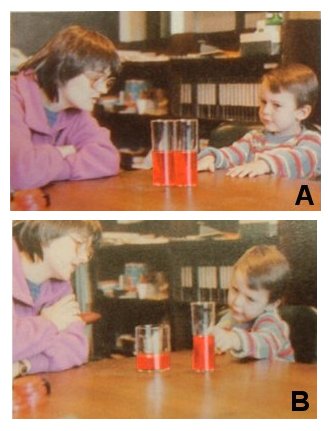
When I think about ways to spice up my intro psych class, I am reminded of a video clip I overheard while returning to my office one day. My colleague was showing his class the home movie he made of his daughter failing to demonstrate "conservation," an understanding that the number of items (M&Ms, coins) doesn't increase simply because they are spaced out more or that the amount of juice in a cup doesn't increase because it has been poured into a narrower cup. It's considered to be a major cognitive milestone that kids achieve around 5-6 years of age. (Adult apes demonstrate conservation too, but monkeys don't.)

Anyhow, the class really enjoyed seeing an abstract concept realized; I think, or they just like watching videos that show young children can't grasp the most elementary of concepts that they all take for granted. One of the great advantages of having kids as a psych prof is that you can actually make a repository of videos of your own kid's infant reflexes, Piagetian tasks and oh, I don't know, various Freudian things that kids are bound to do, like saying they want to marry daddy when they grow up.

My SIL just had a baby, and my sister is expecting one in March, so I suppose I could enlist their help in making footage for my class until I have a subject of my own to work with. (Hint! hint! ) My furry monster canines just won't cut it for the infant reflexes and Freudian departments, but they do a decent job of demonstrating Piaget's "object permanance." Out of sight is nowhere out of mind for Max when it comes to a treat, let me tell you!

One of the reflexes that I find particularly fascinating from an evolutionary standpoint is the "Moro reflex." When an infant is startled or loses head support, the baby's arms fling straight out to the side, fists close, and then come back to the chest as you'd expect to happen if a primate needed to quickly grasp mom's hair in case of emergency. This happens for the first 3-5 months after birth and is one of the most convincing examples that we are primates whose ancestors were hairy.

Infant reflexes can be used to gauge whether the infant has a normal central nervous system. Besides the Moro (no connection to the delicious blood "moro" oranges I love), there's also the Babinski, rooting, stepping, and one I'd nver heard before looking into it today: the swimmer's or "Gallant" reflex. Hold the baby prone supported by your hand on its belly. Stroke one side of the baby's spine. The baby should flex its body toward the stroked side.

The video below (found on YouTube) isn't a perfectly textbook example of the Moro reflex, but I think it comes pretty close. I also think this baby looks too thin!!

Tuesday, October 31, 2006

Feral Children

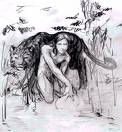
From Romulus & Remus, the mythical founders of Rome, to Mowgli, immortalized by Rudyard Kipling, stories of children raised by animals fascinate students the fictional boyof introductory psychology. The Legend of Tarzan isn't complete fiction. There are plenty of real cases of "feral children" who have grown up to be something other than human, halfway between man and beast. The children seem genuinely wild; having no language, they communicate only in grunts resembling the sounds of whatever animal raised them. Many crawl rather than walk. It takes years to socialize them to live semi-normally among humans and many never learn to talk.

One of my enterprising students showed me this neat website devoted to feral children.

Some wild children have been raised in isolation, as was Genie, who was kept in a closet most of her life with no interaction with anyone. She is probably the best known case of a wild child in this country, but looking at this list it's clear she's got no shortage of company. It seems that many feral children turn up in India. "One explanation is that women with young children or babies would leave their infants at the edge of a field while working, and wolves would emerge from the forest and steal them," says the feral children website.

I think these cases are fascinating because they reveal just how vital early experience with other members of our species is to normal human development. Without contact with others of own kind, particularly adults, humans don't grow up to speak, walk bipedally, or wear clothing. It's not 100% instinctual to do so.

These stories also demonstrate that some animals, dogs and primates, may actually take care of a human infant. One theory is that maternal care is instinctively "released" by cuteness (small body, big head, large eyes, soft wimpers) and that humans are sufficiently cute to some other animals to stimulate the maternal instinct to care for them. It's a little like a vireo feeding the cherry red gaping mouth of the cuckoo who parasitized the nest simply because it's instinctual to drop food into a gaping mouth. Brood parasitism is one of the neatest things that happens in the animal world.