Showing posts with label science. Show all posts

Friday, May 01, 2009

One bright bird brain: MAGPIES!

Add them to the growing list of animals that can recognize themselves when they look in a mirror: magpies. If you don't live in the West, you probably aren't familiar with them, but they are really neat birds that I happen to be rather fond of. They are showy, the West's version of a tropical-looking bird. I know some people don't like them because they're scavangers, but whatever. I think they're cool and they just got a whole lot more cool!

According to research published in the Public Library of Science - Biology, magpies passed the famous mirror test that psychologists have been using since the 1950s to determine when babies (and animals like apes, monkeys, dolphins and elephants) have a self-concept. Presumably, if they show evidence they know the image in the mirror isn't somebody else and show signs they recognize themselves in the mirror, then they have a sense of self.

The mirror test involves placing a mark on the individual while they are unconscious. Controls get touched, but no mark is left. When they wake up in front of a mirror if the marked ones touch the mark after looking in the mirror, they 'pass' the test. They also have to not touch the mark if they're not in front of the mirror.

Self-recognition is linked to highly developed understanding of social relationships, empathy and perspective taking.

According to the researchers, magpies were chosen because they compete with conspecifics for food that they hide and have a memory for where food is hoarded, making them good candidates for complex social understanding. They were also chosen because they're smarter than monkeys, i.e., magpies achieve the highest level of Piagetian object permanence (ability to recognize an object still exists even when it is out of sight, i.e. why peek-a-boo is so amusing with babies) whereas monkeys don't. Magpies are curious and "prone to approach new situations, making them ideally suited for an experiment that requires spontaneous interaction with a new and puzzling context," the researchers said.


Saturday, April 04, 2009

Is autism caused by vaccines? The straight truth.

More and more these days I notice parents who refuse to have their children vaccinated for measles, mumps and rubella because they have heard that the vaccine causes autism. They are all shockingly uninformed, but don't realize it. Part of the problem lies in the fact that they don't realize the one bit of highly publicized research evidence that supports the autism link is riddled with multiple and damning problems. And just this week, it got a lot, lot worse.

According to an investigation by the Sunday Times newspaper, the doctor who sparked the scare over the safety of the MMR vaccine, Andrew Wakefield, fabricated the data that created the appearance of a possible link with autism. He lied. You can read the full article here.

Compared to lying, the other problems with Wakefield's research seem minor in comparison. But nevertheless, even if the results were not made up, the fake-o numbers still do not in any way warrant the autism hysteria that has erupted over vaccines.

And the effect of the hysteria is significant. After the publication of Wakefield's research in 1998, rates of vaccination fell from 92% to below 80% in the UK, according to the Times. And in just ten years, the number of confirmed cases of measles skyrocketed to 1,348 compared with just 56 in 1998.

Aside from the glaring problem with using fabricated data, the other problems with Wakefield's research are threefold, scratch that fourfold!

1. extremely small sample size: The research included only 12 kids!

2. relied on retrospective evidence: Rather than starting out with a sample of children who neither had autism nor had yet been vaccinated, the study used parents who reported autism symptoms after the child was vaccinated. In other words, the researchers relied on parents of autistic children’s memories of events — parents who were understandably upset and far from objective observers.

3. biased sample, i.e. not randomly selected: Almost half of the kids' parents were recruited by a lawyer who planned to sue the vaccine manufacturers. Even Wakefield himself received money to assist the case by finding scientific evidence of the link between autism and the vaccine. You can read more about that here.

4. conclusions overstated the data: The published article stopped short of concluding that there was a causal link between the MMR vaccine and autism. However, when Wakefield spoke to the press he made no such disclaimer. And to this day, outspoken celebrities jump on the bandwagon.

One reason some parents think vaccines caused their child's autism is the timing of diagnosis. The first signs of autism don't appear until around 18 months to 2 years of age, the same time period in which kids are vaccinated. It is this unfortunate timing that makes parents think the vaccines caused the condition. Another case of erroneous correlation = causation thinking.

If vaccines really were causing autism, you'd at least expect to see the incidence of autism rise and fall with the rise and fall of vaccination rates — but it doesn't. You can read the published research yourself here. The article also has an impressive list of other relevant research articles on the subject. I think it's pretty much overwhelming evidence that something other than vaccines causes autism.

Thursday, March 12, 2009

Birth of a baby orangutan

I was going to post on an orangutan who has figured out how to whistle, but the video commentary was inane, and this video of an orangutan giving birth is really neat. I imagine some might find it kind of gross though. After all, she eats the placenta and sucks her baby's head to clean him.


I can't help but to wonder when during human evolution we stopped licking our newborn babies. I've heard some cultures still do this. This sort of grooming also reminds me of some really cool research on mice that found that this initial licking and grooming postpartum is essential for normal physiological development. It kick starts digestion and lays the foundation for how the baby's HPA-axis functions later in life.

The HPA-axis, or hypothalamic-pituitary-adrenal axis, refers to the nervous and endocrine system that regulates the physiological response to stress. Rodents that don't receive early grooming grow up to have abnormal reponses to stressors; namely they release too much cortisol under duress.

Chronically high levels of the hormone cortisol have been shown (including among humans) to be associated with a weakened immune system, depression, and brain atrophy. That's really putting into a nutshell what I learned in what may be the most freakishly awesome seminar I took during grad school: Psychoneuroimmunology, or PNI.

If you would like to learn more about how behavior, mood, hormones and the nervous system interact to affect your health I highly, HIGHLY recommend the book Why Zebras Don't Get Ulcers by Robert Sapolsky. Although he is as mega-scientist who professes at Stanford, the book is as readable as it is fascinating and entertaining. I freaking loved this book! Of course, he's also a primatologist and he has a wicked sense of humor. His other books are fantastic too, by the way. You cannot go wrong.

I still remember the day back in grad school when I was in the mail room and a fellow (newbie) grad student (who came to study PNI specifically) saw the book sitting on the counter and made some snide remark about how he hated it when laypeople jumped on the stress/immune system bandwagon and didn't know what they were talking about. It was then that I decided that he was an arrogant, ignoramus little snot. He had no clue who Robert Sapolsky was. Maybe Mr. Sapolsky shoulda put his big PHD behind his name on the book cover. In any case, I got the last laugh that day. I don't even know why I even still remember that, honestly, but it evidently made an impression.

Friday, March 28, 2008

Isn't this littering? Japanese scientists want to launch paper airplanes from space.

Japanese scientists want to launch paper airplanes from space. Scientists from Tokyo University’s Department of Aeronautics and Astronautics have been collaborating with origami masters to fold airplanes that can be launch from space to float back to earth. I kid you not.


This has to be the most odd story I have come across in along while. I am still in disbelief that paper airplanes could survive re-entry, but apparently a prototype passed wind tunnel durability tests in February.

The prototype was about 3 inches long and 2 inches wide. It survived Mach 7 speeds and 446 degree heat — conditions that were meant to replicate conditions during re-entry. Apparently the little paper plane suffered no major damage or burns.

A successful flight from space by an origami plane could have far-reaching implications for the design of re-entry vehicles or space probes for upper atmospheric exploration, says project leader Shinji Suzuki.

“It sounded like a simply impossible, crazy idea,” Suzuki said.

I have to agree. Paper? A paper plane wouldn't bust apart or be instantly incinerated? The freakin' Space Shuttle has blown up twice and PAPER is supposed to work?

The Japan Aerospace Exploration Agency thinks so. They are spending $300,000 in funding per year for the project.

The origami airplane can survive these harsh conditions because it's made from sugar cane fibers that happen to make the paper resistant to heat, wind and water. The plane is also sprayed with a special coating, of exactly what they don't say.

Japanese astronaut Koichi Wakata has apparently expressed a personal interest in the project and has offered to throw several origami shuttles into the wake of the international space station.

The Tokyo University scientists hope lessons from the paper planes could lead to the development of new lightweight space probes or help to design a full size paper space shuttle.

The biggest hurdle?
They have no way to track or predict where the paper plane will land.

But Suzuki says he has a solution — a message of peace in several languages, along with a request for anyone who finds them to notify the team.

“Just imagine, children around the world would be anxiously waiting for the return of our origami shuttle, perhaps looking up into the sky from time to time,” Suzuki said. “That would be great fun.”

See the story here.

Friday, December 21, 2007

Perfume: The Story of DNA & Desire

The movie Perfume: The Story of a Murderer begins with scenes that are not for the faint - blood, maggots, vomit, vermin, rotten fish - foul sights, surely putrid smells. If you can stomach the intensity, the movie is about Jean-Baptiste Grenouille, a man who was born with an acute sense of smell. Driven to create a perfume that captures the essence of a woman, he obsessively pursues the perfect scent to the point that his obsession moves from creativity to murder.

Though fictional, the story symbolizes our species' fascination with scent - and perfumery. The practice of creating scents to apply to skin, hair, body, fabric and living space dates back as far as there has been written history. Perfumery began before anyone ever heard of the three wisemen who brought frankincense and myrrh for a certain baby. Rather than go into the history of perfumery, I'd like to introduce you to the science of it. It's one of my very favorite subjects!

Figuring out which scents appeal to the broadest base of people is one way that professional perfumers can maximize their profits. Another way is to somehow target scents to people who most like a particular scent or scent family. Although perfumers have been at it for along time, research into why people prefer the scents they do is just getting started.

You may have heard that most people like vanilla, and that is generally true, and that some people like ylang-ylang, but others hate it. The same goes for patchouli; it's hit-or-miss. What you may not know is that scientists have figured out that whether people like a scent has to do with their genetic makeup, specifically the part of it that codes for proteins on the surface of certain immune cells.

MHC is a stretch of DNA that creates proteins of the surface of immune cells that help the body recognize and differentiate 'self' from 'non-self.' MHC has profound implications for our ability to stay healthy, but research from Wedekind has also turned up some fascinating connections to its role in body odor, perfume preference and even mate selection.

MHC influences body odor. Don't ask me how it does, it just has to do with bacteria, armpits, and crotches. People can actually detect the subtle MHC-based differences in body odor, and when asked to sniff the worn shirts of potential 'dates' and 'mates,' people routinely choose as the "best smelling" those people whose MHC is different. Humans prefer a significant other whose genes are different. This makes good evolutionary sense. That combination would produce offspring who's immune system has a good chance of being able to detect a wider range of germs, thus being healthier.

Wedekind's team of scientists discovered that people who have the same genetic code for MHC like the same scents. It hasn't been studied yet, but it stands to reason that perfume preferences would "run in families." Are sisters and mothers genetically programmed to select the same aromatherapy products from Bath & Body Works? Not exactly. It's not like such convenience was available in the nature red in tooth and claw days (and nights) of our ancestors' time. But - Wedekind's research suggests that people select perfume and odors to augment their own naturally occurring odor and DNA.

Other lines of evidence suggests that we've been evaluating others' mate potential based on their scent (and consequently MHC, DNA) for a very long time. I think humans used various natural odors in ancestral times to augment body odor and still use it in modern times to make ourselves more appealing to the opposite sex. Wedekind's other research suggests that we choose and reject mates based in part on their body odor. And, a few studies have even found that choosing mates with the wrong MHC actually affects fertility.

Nowadays we manipulate our body odor to maximize our appeal to others and alter our mood. The mark of a true Darwinian winner is whether or not you actually choose artificial scents that match your MHC - and - whether you choose a partner to reproduce with who likes what you like, but only to a point.

Next time you look at the tiny flower sewn to the center piece of a brassiere, recognize it as the modern day version of a little satchel of fragrant roses, oils, and herbs that women once pinned between their breasts to perfume and provoke - desire.

Tuesday, November 28, 2006

Snowflakes

In honor of the first snow fall of the year in my home town, I present some snow factoids:

Is it true that no two snowflakes are exactly alike?


Yes, say researchers at Caltech. Kenneth Libbrecht, a physicist, has studied the growth of ice crystals in controlled laboratory settings. Ice crystals form around a speck of dust and grow differently depending on the air temperature and humidity. In real life, snowflakes float through the air where temperature and moisture constantly change. Just as no two people have the same developmental history, no two flakes have the same growth history so each is unique.

What causes pink snow?

While it's true that sometimes shadows cast on snow appear to have a pink hue, the bright pink almost reddish tint of "watermelon snow" is a totally different phenomenon. A certain species of algae, Chlamydomonas nivalis, produce a red pigment in addition to the familiar green-tinted chlorophyll produced by plants. This algae thrives in frozen water and when compacted, by stepping on it with a snow boot, the color intensifies. Watermelon snow can be seen in late spring and early summer in old, packed snow at around 10,000-12,000 feet in the Sierra Nevada mountain range in CA. The red tinged carotenoid pigmentation is what gives tomatoes, peppers, lobsters, corals, and shrimp-eating flamingoes their distinctive crimson color. You can see examples of pink snow here.

Snowflake, the Albino Gorilla

Snowflake, the world's only known albino gorilla, lived in the Barcelona Zoo. He was captured from the wild in the 60s in Equatorial Guinea when he was an infant and lived about 40 years in captivity until he died from cancer. He sired 21 offspring and 10 grandchildren, including twins.

Albinism is a recessive genetic trait so both of Snowflake's parents had to have the gene that causes the condition. The gene alters the amino acid tyrosinase which is a necessary building block for the proteins that pigment hair and skin.

Snowflake was not treated any differently by the other gorillas in his community on account of his odd skin and hair color -- a lesson we humans ought to take to heart.

Wednesday, November 01, 2006

Cranberries

The Today show featured a short segment on cranberries and bogs. The announcer really wanted the cranberry grower to explain how the whole bog thing works, but all he could do was point out some short bushes with little red berries. Left hanging on the vine was the question of how one goes from there to the picturesque water filled bogs. I wondered the same thing myself, so here's what I found out about cranberries. They're really interesting berries. (I still don't think they taste particularly good!). The berries are harvested by flooding the field they're grown in (a bog that has peaty, acidic soil) and then agitating the water with this device to loosen the berries. The floating berries are then sluiced from the surface.

Cranberries are native to New England and grow well in acidic soil (just like azaleas & rhododendrons). The name is probably a variation on the colonial "crane berry" so named because the flowers resemble the sand cranes that could be seen eating them. The Ocean Spray company produces 90% of the world's supply, grown in northern climates (MA, WA, OR, BC) only because milder climates create problems with fungus.

Cranberries are also well known for promoting urinary tract health. And, it's not all hype. In 2002, JAMA reported a study that suggests persistent urinary tract infections that are resistant to antibiotics could be prevented by drinking cranberry juice. The researchers found that cranberry juice prevents 80% of bacteria from attaching to the cells of the urinary tract. These anti-adhesion effects have been isolated to compounds called proanthocyanidins - yep, a cyanide relative. Cranberry juice is a real, viable alternative to participating in the evolution of antibiotic resistant bacteria.

Speaking of that, recently my Newfie puppy had to visit the vet for what they labeled a bladder infection. They allegedly did a test that showed she did have an infection, and of course, sent us home with antibiotic pills. She still dribbles. So, now I'm thinking it wouldn't hurt to put her on a cranberry juice routine. She may not like the tart treat as much as she enjoyed that peanut butter pills, but maybe it would be a good long-term solution.

The Cranberry Institute reports that the bacteria that cause periodontal gum disease are also sensitive to cranberry juice. That seems like good reason enough to drink the stuff, but did you know that blueberries are just as good?

Blueberries, in addition to having the anti-adhesion properties of cranberries, also have anti-proliferation capacity. They prevent cancer cells from replicating. Cool.

And, blueberries taste much better!

The Rutgers Blueberry and Cranberry Research Center is working to breed berries that have higher concentrations of medicinal properties.

Wednesday, October 25, 2006

Soy & Phytoestrogens

Last week I finished reading an article from Hormones and Behavior about the metabolism of hunger and sex drive. Within it, I learned some more interesting factoids about the consequences of ingesting soy. I think I drink a lot of soy, and I also eat tofu occassionally, so I am interested.

I'm still trying to wrap my head around the wide-ranging article, to fit the pieces together myself, so I'll just report some of the more interesting elements of the story.

1 - Fat cells have estrogen receptors! Mice without working estrogen receptors become obese.

2 - Body fat distribution is more critical to long term cadiovascular health than body fat content or BMI. Gluteofemoral fat deposits are cardioprotective. So, if you have an hourglass figure (narrow waist with wide hips and fleshy butt and hips - an hourglass/pear figure rather than an apple) you're at reduced risk of heart disease. Also, women with a .70 waist to hip ratio (the hourglass figure) have higher fertility.

3 - Insulin levels are associated with visceral (deep belly) fat, whereas leptin levels are associated with subcutaneous gluteofemoral (butt, hips, thigh) fat. Hormones of the HPA axis (hypothalamus - pituitary - adrenal glands), such as cortisol, are also implicated in body fat distribution. Stress may cause you to put on more visceral fat.

4 - Eating disorders (of which the author seems to be primarily interested in obesity) may arise from changes in neural sensitivity to estrogen that occur early in brain development.

5 - These changes might be intitiated by exposure to phytoestrogens in our diet and pollutants.

So, evidently, consuming soy is cardioprotective and reduces the risk of developing obesity only when consumed as an adult. BUT - and this is a big but - consumption of soy during pregnancy or exposure of a fetus to soy and phytoestrogens actually increases the risk of cardiovascular problems and obesity.

Pregnant women and infants should not consume soy or any products containing phytoestrogens because the phytoestrogens bind to the body's estrogen receptors in the brain, various internal organs, and particular body cells like fat cells. This leads to organizational changes in the infant's brain that masculinize a female's body fat distribution after puberty: more visceral fat around the waist, less around the hips and butt. This places her at greater risk of developing heart disease and obesity.

The paper, however, focused on an evolutionary theory that there are brain mechanisms dependent on hormones that serve to signal an animal when it's time to eat vs. mate. The author explored the metabolic control of hunger inhibition, arguing that such a mechanism is adaptive because it would "bring the cessation of hunger and eating long enough to find and court potential mates." She suggests that the hormone leptin, known as a hunger hormone because high levels of it inhibit appetite, should come to be viewed as a sex hormone too. Evidently, leptin enhances sex behavior - in rats and mice. It stimulates the preference of having sex over eating. The author also argues that the hormone neuropeptide Y which is known as an appetite stimulant, should also come to be viewed as a sex hormone that stimulates the preference for food over sex.

Friday, October 06, 2006

Split Brain

Last night's episode of Grey's Anatomy depicted a patient who underwent a "corpus callosotomy" and then was unable to identify his wife, baby, and a simple object in the room (a cup placed in front of him).

This didn't jive with my understanding of the effects of the procedure, also called a "split brain" operation in psychology. It's a topic that gets brought up in intro psych classes because severing the corpus callosum (a bundle of neurons that connexts the two hemispheres of the brain) produces very interesting side effects that stem from the lack of coordination between the two halves of the brain. It provides a neat case study for understanding how the hemispheres work and also showcases the concept of lateralization - the idea that some functions (such as language) are "specialized" and carried out on one side of the brain.

As the show correctly implied, a split brain procedure is done to treat severe seizures. Cutting the nerve bundle limits the spread of the seizure to the whole brain and greatly reduces the severity of the tremors. It can be done in two stages - the first cutting only the front two thirds of the fibers, leaving the rest intact so the the hemispheres can still share some information. If the seizures are still problematic, the rest of the fibers can be cut.

A full corpus callosotomy creates some interesting side effects - but not the severe one depicted on the show of not being able to identify anything.

What actually happens is that the "split brain" person cannot say out loud the name of an object that is ONLY presented to the LEFT visual field (if the person is left hemisphere dominant for language). The patient would have to close the right eye completely for this to happen. In laboratory tests, split brains look at objects through a tachistoscope that presents information to only one hemisphere or look at image that is flashed briefly to one side of the visual field.
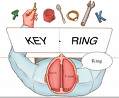
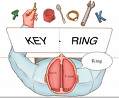
A left hemisphere language dominant "split brain" who viewed an object (spoon, as in the diagram) with only the left visual field would not be able to identify it because that visual input is received by the right hemisphere which can't communicate with the left hemisphere where speech is generated. The person would recognize the spoon but be unable to say it. If asked to pick up the object with the left hand (which is controled by the right hemisphere, the one that saw the object) out of a collection of objects out of sight, the person would correctly pick up the spoon.

These kinds of effects don't usually cause problems for the person because information comes in through both eyes!!!

That's where Grey's Anatomy only captured half of the story. They dumbed it down considerably and even played up a seriously dumbed down version of the brain lateralization story. "McDreamy" the brain doctor said, in explanation of the patient's side effects, that it will take a while for emotional messages to travel to the other side of the brain where information is processed.... or something like that. I wanted to gag.

Anyhow, if you'd like to learn more about split brains, the study of which won Roger Sperry the Nobel Prize for medicine, check out this cool site:

A split brain game you can play.

One of the things that helps to understand, on a deeper level, why the split brain person experiences these weird side effects is that the eyes are connected to the hemispheres in a really unsual way.
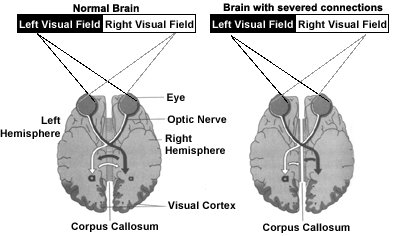

The right half of each eye's retina projects to the right hemosphere (shown in dark grey in the diagram above) while the left half of each retina (white) projects to the left hemisphere. Also, half of the retinal fibers (the nasal halves, closest to your nose) cross over to the other hemisphere at the optic chiasm. This means that the temporal halves (the right side of your right eye and the left side of your left eye) don't cross over at all. Your nasal retinal halves can be completely blocked and you'll still have a full field of view because the temporal halves cover the whole field. If you don't believe me or the diagram, hold three fingers right in front of your nose.

I could deliver an emancipation proclamation of the the evolutionary reasons for this weird set up, but suffice it to say that this arrangement allows us to have excellent depth perception.

It also means that a split brain person only receives information that can be verbally identified by one fourth of the available retinal area - the quarter that projects to the right visual field which is on the left side of the left eye (shown in white in the diagram). Notice those fibers don't cross to the other hemisphere; they are the ONLY fibers that project straight back to the left hemisphere. So, only information presented to the right visual field can be verbally identified.

All of this makes me wonder - is the optic chiasm cut during the corpus callosotomy and if so, does the person lack depth perception?

I assume it is cut because all of the textbooks on the subject present the fancy little images of the right and left visual fields and the projections to the nasal and temporal halves, but the side effects would be the same if the retinal inputs could cross over because the two retinal halves would see the same thing. In that case, the brain could still compute the difference in distance from the right and left eye's inputs and triangulate the distance.

Anyhow, that's probably more than you wanted to know about why I thought Grey's Anatomy flunked last night in the way they presented the split brain patient. It's great - I'm glad they did. Maybe somewhere out there someone taking intro psych watched it and realized the same thing I did and actually asked their psych prof about it later.

Thursday, October 05, 2006

Lactose Intolerance

Over the weekend a good friend of mine visited for our college reunion. She's lactose intolerant and likes to enjoy ice cream and other dairy products so she brought lactase pills along with her so she could digest the milk sugar lactose. She was also told by her pediatrician the day after she returned home that she's got to fatten her one year old daughter up. I asked her how she's supposed to do that. Cheese! Makes sense, but she's worried her daughter might be lactose intolerant too. Being fully capable of digesting the stuff myself, the concept of lactose intolerance is not something I spend much time thinking about... until recently.

According to Steve Lewis, a professor of Darwinian medicine, mammals lose the ability to digest milk with age. This might "form a biological mechanism whereby the ties between mother and child are broken so that she can go on and have more offspring and the child can go and have offspring of its own." Symptoms of lactose intolerance include gas, bloating, abdominal cramps and diarrhea result. The NIH estimates that in the U.S. about 15% of people of European descent have it. Half of Latinos, 60-100% of Native Americans, 80% of African Americans, and 90% of Asian Americans are lactose intolerant. The ability to digest milk depends on how heavily a culture depended nutritionally on the milk of their herded animals.

What is really interesting to me from an evolutionary perspective is that lactose intolerance is something all humans should experience yet many don't. Relatively new research has discovered a genetic mutation that gave some adult humans the ability to digest lactose. This occurred sometime in the last 5,000-10,000 years and coincides with the origin of pastoralism in Europe.

This finding poses challenges to evolutionary theories about human behavioral adaptations (such as males' preference for mating with nubile women) that are thought to take hundreds of thousands of years longer to develop in a population. EPs can't go back in time to determine what kind of ecological conditions human ancestors lived in at the time we were evolving these adaptations (the so-called "environment of evolutionary adaptedness"), so most EPs infer what kind of behavioral adaptations would have been most adaptive for our ancestors by examining the ecological conditions of extant human hunter-gatherers. They assume the living conditions are essentially the same and that not enough time has passed for new adaptations to take hold, so if it would be adaptive for hunter-gatherers now it was probably adaptive in the past too. Obviously trouble arises when new evidence suggests that humans can evolve faster than expected. If a gene for making lactase well into adulthood can take hold in the last 10,000 years it is also possible that a gene for constructing hypothalamic-visual cortex connections in the brain that fire maximally for men viewing nubile young women could take hold that fast too. I seriously doubt that there was ever a time when the average man was turned on by the sight of a pre-pubescent or wrinkled old woman. It wouldn't make much sense for successful reproduction.

However, there are other adaptations that are more controversial and could conceivably be a product of relatively recent changes. The female orgasm, the desire for men to have more sex partners than women, sexual jealousy, monogamy, etc.

The discovery that lactose is newly digestible does NOT mean evolutionary psychology is a rotten paradigm, as some would have it (David Buller), but it does mean that care needs to be taken when hypothesizing adaptations that assume nothing has changed within the last 10,000 years.

As for my friend's daughter, she should be able to digest cheese just fine. Lactose intolerance doesn't set in until later in life and is a recessive trait, so if her dad can still digest lactose, she should be able to later in life too.