Showing posts with label evolutionary psychology - general. Show all posts

Thursday, February 12, 2009

Cucumbers & Morning Sickness by Design

Cucumbers must have some highly toxic components because they continue to be a food that smells absolutely disgusting to me. Unfortunately, someone who sits near me at work loves them. Fortunately though, the scent aversion is all part of the mind's design — a pregnant mind.

Morning sickness, or rather pregnancy sickness for it truly occurs at any time of day, appears to be a bona fide adaption in an evolutionary sense. It's adaptive, meaning it is helpful for us as a species, but more than that, it is an adaption — a mechanism with enough complexity, precision, and efficiency to indicate a functional design.

Long, long, long before I ever became pregnant I read Margie Profet's landmark research on the evolutionary significance of morning sickness and was impressed enough to remember that although it is seriously annoying — it is actually a very good thing to experience while pregnant. It means the baby has a higher chance of being healthy and a lower chance of miscarriage.

What I didn't recall, until I recently reread the paper, is that the evidence is actually quite impressive. I also learned that the author herself is impressive. Having never formally studied biology or evolution and with only a BA degree — and a brain — she scored a $250,000 MacArthur Foundation Genius Grant to study the phenomenon. Freaking awesome! And jealous! I could have spared myself all those wasted years slaving away in grad school... grrrr. However, they did land me a couple of killer teaching positions!

So, McGenus Profet accumulated the evidence that showed that the nausea, food and scent aversions, and vomiting associated with the First Trimester of pregnancy represent an adaption. Previously, it had been thought that it was all a sickness, a side effect of pregnancy hormones with no benefits, only costs. And, those costs are significant. Women who experience pregnancy sickness can experience weight loss and inadequate nutrition from avoiding and/or throwing up nutritious though unpalatable foods. But there is a method behind the months of madness.

Evidence pregnancy sickness is an adaption
  • Many foods contain compounds that can produce malformations, sometimes fatal ones, in developing embryos.
  • Women who have pregnancy sickness selectively avoid foods that indicate those toxic components are present.
  • The onset of pregnancy sickness coincides with the time the embryo becomes vulnerable to the toxins.
  • Pregnancy sickness ends when the embryo's need for calories for growth outweighs its vulnerability to the toxins.
  • Changes in the olfactory system of a woman who has pregnancy sickness cause her to avoid substances with those toxins. Basically, a more sensitive sense of smell and lowered threshold for finding scents disgusting help a woman avoid foods that could harm the developing baby.
  • Finally, and most important for establishing pregnancy sickness is adaptive, women who experience moderate to severe pregnancy sickness have greater pregnancy success rates.
Cool beans if you ask me! The part I forgot was the 'sickness' ending when the fetus isn't as vulnerable as it is hungry.

So the list of no-go foods? The article pointed out that celery, cabbage, cauliflower, brussels sprouts, bananas, oranges, apples, potatoes, soybeans, black pepper, cocoa and nutmeg (among lots of other foods, especially green, leafy veggies) all have compounds that are known carcinogens. Although they are in small enough quantities to be safe for adult consumption, they are harmful to a fetus.

So glad, in way, to have experienced the morning sickness phenomenon! Equally glad, if not more so, that it is going away!!

Thursday, December 11, 2008

Heartaches are heroes when their pockets are full

One of the classic studies from Evolutionary Psychology, one that gets mentioned in all the textbooks and is known to all students of the field, perfectly illustrates a line from the Rosanne Cash song Seven Year Ache: Heartaches are heroes when their pockets are full.

It's best known as the "Burger King study." The researcher, John Marshall Townsend, an anthropology professor at Syracuse University, dressed the same man in two different ways. One was a Burger King uniform, and the other was a white shirt with nice tie and watch and a navy blazer. He had women look a photo of the man and evaluate to what extent they would: like to have coffee with him, date him, have 'uncommitted sex' with him (a favorite question of EP), have a serious involvement with him, have a serious sexual relationship, and marry him (another favorite EP question). Unsurprisingly, women across the board rated the nicely dressed man higher.

Perhaps a better song and line to pair with it is ZZ Top's Sharp Dressed Man: Every girl's crazy 'bout a sharp-dressed man.

The real question then becomes why? Why do women prefer a sharp-dressed man. Ah, sure, women want a good provider. But why? The answer depends on who you ask. Ask an evolutionary psychologist and they'll tell you it's because ancestral women who chose men to mate with who showed signs of status and wealth left more offspring than women who were indifferent to wealth. Ask a member of the "Flat Earth Society," what some evolutionary psychologists call women's studies departments, and they'll say it's because women learn to prefer wealthy men because that's what our culture values. I say it's what our culture values for a good reason: Those values helped us thrive as a species.

The need for women to prefer wealthy men has a lot, I think, to do with the ecological conditions women have customarily faced, namely, lower status. Another significant one is having babies that are metabolically costly and also incredibly difficult to care for, compared to other species. Human babies are basically born before they should be. They come out of the womb much less developed and far more dependent on mom than other primate babies, including other great apes, who also have very dependent babies. Human babies require significantly more care and that is made a lot easier with the help of another parent who can provide food, shelter and protection. The higher status the helper, the better fed the baby and the more likely to survive. That's how the theory goes.

There are some feminist evolutionary psychologists who doubt whether that helper actually was a male sexual partner. The other helper (or helpers most likely) could have been a mother, grandmother or other females raising babies cooperatively.

Monday, September 15, 2008

A monkey faster than Usain Bolt: The Patas Monkey


Able to reach a top speed of 35 miles per hour, the patas monkey is the world's fastest primate — not Jamaican Olympic sprinter and (human) world record holder Usain Bolt, contrary to what his apparently grandiose ego might have you think.

Speedendurance.com clocks Bolt's top speed at 27 miles per hour.

Now, Bolt is certainly impressive in his swiftness. And he is equally entertaining with his posturing and chest-thumping. But, I think the patas monkeys would yarn and roll their eyes in his general direction. Try running with pack of hungry hyenas on your tail, and then we can talk they might say.

Come to think of it - that would make the Olympics a whole lot more fun.

Because of their impressive speed, the Patas monkey is my September selection in the Monkey of the Month club.

Like the other OrnaMonkeys I've created, I chose to highlight it not only for its unusual appearance, but also for its amazing running ability.

This Old World monkey, native to central African savanna, has a body that suggests it is built for speed, something that's not surprising for a wily little monkey that inhabits grassland among big cats and other scary predators. They have a slender body, long hind limbs and a deep chest cavity to make room for oversized lungs.

The patas monkey is one of the only monkeys that spends its life almost entirely on the ground.

These monkeys are really, really cool. Since there's no video of patas monkeys racing Mr. Bolt, you'll have to settle for this parody I found if him on youtube. It's pretty funny, especially if you saw his chest beating during the Olympics.

Monday, August 25, 2008

Magpies recognize themselves in a mirror

Self-recognition, once thought to be an ability possessed only by select primates, has now been demonstrated in a bird — the magpie.

So they aren't mere bird brains after all say newspapers all across America today. The AP moved a story today about how magpies pass the classic 'mark test.' PLoS Biology, a peer reviewed journal, published the study. I haven't read it yet, but am eager to - just as soon as I get my other work done! It looks promising and in the meantime, I found a nifty video the research team put together showing the little guys in the test. You can view it at the very end.

In the test, individuals are marked with something, usually a dot of paint or a sticker, in a place they can't see on themselves without using a mirror. Half the time, the mark is conspicuous. The other half it blends in. For the magpies, stickers were used — highly noticeable yellow ones and inconspicuous black ones.

The birds scratched at the yellow ones and left the black ones alone. And, supposedly that means they can recognize themselves in mirrors and by extension have a sense of self — a self concept in other words. To be aware of oneself as an individual is pretty high-level cognition, very few species even have a clue.

I've written about the mark test before, back when elephants made headlines for passing the mark test. Dolphins also pass the mark test. You can read more about the elephants and the meaning of mirror self-recognition here.

Though they are from vastly different evolutionary lines, what these species all share is a significantly large brain for their body size. Why species develop big brains is an even more fascinating subject.

Until next time, enjoy this great magpie video.


It's just about enough to make me want to raise magpies. They do seem really smart — them and crows. But they'd make an even bigger mess than two newfoundlands. I think I'll leave the bird studies to the ornithologists.

Thursday, February 21, 2008

The Evolutionary Explanation for the Link Between Mental Illness & Creativity

Is it true that mental illness is associated with creativity -
or is that just a myth?


There is a bit of an evolutionary puzzle surrounding the persistence of mental illness, particularly debilitating conditions like schizophrenia. Many forms of mental illness are heritable and also associated with dramatically reduced ability to cope effectively with day-to-day life. If such conditions interfere so dramatically with life, wouldn't they impede reproduction too? Of so, then why do genes linked with schizophrenia persist?

The authors of the research article Schizotypy, creativity and mating success in humans provide some intriguing answers to this paradox. Their article was published in the Proceedings of the Royal Society, a well-respected journal, in 2005.

Schizotypy refers to a personality type that shares many of the same traits as schizophrenia, but not to the same extreme. The traits are:
  • magical thinking, unusual experiences
  • attention & concentration difficulties
  • impulsive non-conformity (rash, reckless behavior that is eccentric)
  • introverted anhedonia (social withdrawal, lack of enjoyment)
Several studies have found that artists and others active in the creative arts have elevated levels of some of these schizotypal traits. Specifically, the first and third.

In fact, artists and poets score as high on those two traits as schizophrenia patients do.

These are also traits that should theoretically lead to having more sexual partners, and hence, greater mating success. That final part is an important piece of evidence the authors use to explain why these traits persist in the general population. I should point out that the number of children schizotypal people have is a more valid measure of reproductive success than their number of sexual partners.

The authors of the study looked at correlations between the personality traits, creativity, and sexual activity. They used a sophisticated type of statistical analysis to guess at the causal relationships. Correlational data can never be used to determine whether one thing causes another, such whether being schizotypal causes one to produce more art. For that you need an experiment that manipulates one to see the effect on the other. However, path analysis can hint at causal relationships.

Using path analysis, the authors found that having a lot of unusual experiences ( I wish they had given some examples, but they didn't - boo) affects artistic output, which in turn affects sexual activity. What this means is that more prolific artists have more sexual partners.

This is consistent with psychologist Geoffrey Miller's theory that artistic creativity functions as courtship display - something akin to a peacock strutting its feathers.

Thursday, January 17, 2008

You Get What You Pay For: Price Affects Pleasure, Study Says


Researchers have discovered that one clever marketing tactic – raising the price of a product – causes the brain to play tricks on itself.


People who sampled the same, but higher-priced, of two product lines reported more pleasure from it.

What's more, a part of the brain associated with pleasurable sensation, the medial orbital prefrontal cortex, lit up like Christmas when participants had the more expensive of the two products.

They were tasting wine. Apparently, when it comes to wine tasting, the pleasure is in the price.

The study, published this week in the Proceedings of the National Academy of Sciences, had people sip wine labeled from $5 to $90 and rank its pleasantness, among other qualities. Although the Cabernet-Sauvignons were identical, people reported enjoying the 90 dollar bottle the most – and the unconscious activity of their brains backed them up.

However, two weeks later when volunteers were asked to rate the wines in the absence of price information, they liked the lower priced wines the best.

Who knows whether the results of this study apply to anything else, but it stands to reason that if people think expensive wine tastes better, then a whole range of other products might enjoy a similar bump in enjoyment, albeit temporary.

Every so often I hear people at etsy.com ask whether the price of an item affects whether people will think it's of higher quality, and therefore be justified in paying the higher price. Should they price their art higher to signal its greater value to a consumer? Would people who see a scarf priced at $120 think it's a better scarf than a similar one priced $40?

This study suggests their intuition is right n the money. However, if a buyer purchases the higher priced item thinking it's "better" then what happens two weeks later when they've finally received it? Will they continue to feel it's a higher quality scarf?

I would venture a guess, that yes, they would.

Even though the wine study suggests the scarf buyer might think they were 'ripped off' upon realizing the higher priced scarf isn't any better, unlike the people in the wine study, the scarf buyer has placed his or her own money on the table, not someone else's. And that makes all the difference. So go ahead, buy the scarf you like even if it carries a large price tag – you'll like it even more. The one pictured here was woven by Mr. Field Notes, and is for sale, by the way.

Tuesday, May 08, 2007

Uakari Monkey & The Origin of Blushing


It is said that humans are the only animal that blushes.

Uakari monkeys have bright red faces and are unusual among primates for it. But they don't blush. I don't know how anyone would be able to tell even if they did!

The evolutionary origin of their bright red faces is as about as big of a mystery as why humans blush.

One theory about uakari monkey facial redness is that it's a sexually selected trait associated with testosterone. A related theory says it advertizes health.

These neat-o small (9 pound) monkeys live in South America, really are that white (at least this subspecies), and are reputed to be monogamous.

Uakaris, along with bearded saki monkeys, might be the only primates other than humans that form large groups made up of monogamous pairs. These monkeys are NOT well studied so they may not actually be monogamous. The ARKive site has some really great footage of uakaris.

Blushing, like any other nonverbal behavior with communicative value, fascinates me both academically and personally. You see, seldom am I embarrased to speak in public; it's an occupational hazard after all, but, every once in a while a totally uncontrollable and horrible blush sweeps across my face, neck, and upper chest. I can feel my skin heat up, sometimes I sweat. What is weird is that rarely in such instances do I actually feel embarrassed, yet there it is blazing, bright freaking red, red, red. I even blush alone. I think it must be related to hot flashes, but I am way too young for that. To add insult to injury, I am incredibly pale-skinned, so even the slightest blush can be seen from afar, like the fire truck roaring down the street yelling at everyone to get the hell out of its way.

Bright red faces are not unknown in the animal kindom. Primates, and famously humans, become red with anger. Here the red signals, indeed, SHOUTS: Get away!!!

I would argue that reddened faces during anger make it possible for socially grouping animals to maintain those groups in spite of frequent conflicts which inevitably emerge whenever individuals must live together and use the same resource pool. Having a signal that indicates to everyone else that you are pissed off and which prompts others to get away from you protects everyone from fighting, injury and group disintegration.

Why we would show rage on our faces rather than some other part of the body intrigued Darwin, who wrote about that and the subject of emotion and facial expression in The Expression of the Emotions in Man and Animals. I love picking up the book and reading it but I find it incredibly frustrating because it is mostly (80% I'd say) descriptive with little evolutionary theorizing about why animals and humans have the facial expressions they do, including that of shame. Needless to say, in the last few days of pondering my impending unemployment, I thought about writing a textbook about nonverbal communication across animal species! I found out when prepping my nonverbal behavior seminar that there isn't anything on the market that does even a decent job of reviewing the relevant research. Much of what exists is pop-psychology rubbish.

But, back to the point. Rage and shame are not the same, but maybe both work to hold groups together. Darwin didn't offer up a compelling theory of why people, alone in the animal kingdom, blush. Perhaps, as he hints, it has something to do with us being one of the few species that has a self-concept. In order to blush, you have to know you exist independently from others. This is why humans don't tend to blush until about age two, right around the same time they "individuate" and realize they are not the same person as mom and dad. Congenitally deaf and blind people blush.

The one theory that Darwin presents and subsequently rejects in The Expression argues that the Creator (today we'd call it an Intelligent Designer) made us blush when we do something that violates the rules of our social group so that others will know we regret it. I like the theory a bit. Yet like Darwin, I think evolutionary forces made it so. If a signal makes others want to keep us on the island when we screw up, such a signal could evolve through natural selection. It could also have arisen through group selection, sexual selection, or random genetic drift.

You know what's interesting? The face becomes red and then we feel the heat from the flush. Thus, others see the signal before we even know we're blushing.

Tuesday, September 12, 2006

From Phrenology to Modules

Mapping the mind's black box.
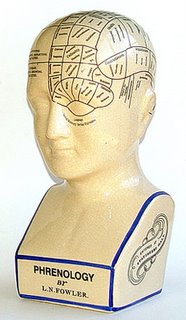
The history of psychology is a relatively short but varied one, replete with many wrong turns. One of these is phrenology, the art and sometimes science of reading personality from bumps and recesses on a person's skull. Invented by Franz Gall, phrenology's heyday expired near the end of the 19th century. The basic idea held that the brain was an organ like no other, for contained within its black box were several suborgans, each with a different function. Running with the idea that the size of an organ tells us something about its usefulness for the organism, Gall reasoned that we could deduce the relative importance of each suborgan for each person based on the imprint it made on the head. For a more complete picture of phrenology, check out this excellent online phrenology resource from the British Library.

Like many wrongheaded ideas in psychology, phrenology has become like what astrology is to astronomy today. Neuroscience has come a long way since then, but we can still see vestiges of Gall's idea in the ideas from two founders of Evolutionary Psychology: Leda Cosmides and John Tooby.

First, more on Gall's organs.
He proposed 27 of them, listed below. The final 8 he thought were unique to humans but the rest we share with other animals.
  1. The instinct of reproduction (located in the cerebellum)

  2. The love of one's offspring

  3. Affection; friendship

  4. The instinct of self-defense; courage; the tendency to get into fights. The carnivorous instinct; the tendency to murder

  5. Guile; acuteness; cleverness

  6. The feeling of property; the instinct of stocking up on food (in animals); covetousness; the tendency to steal

  7. Pride; arrogance; haughtiness; love of authority; loftiness

  8. Vanity; ambition; love of glory (a quality "beneficent for the individual and for society")

  9. Circumspection; forethought

  10. The memory of things; the memory of facts; educability; perfectibility

  11. The sense of places; of space proportions

  12. The memory of people; the sense of people

  13. The memory of words

  14. The sense of language; of speech

  15. The sense of colors

  16. The sense of sounds; the gift of music

  17. The sense of connectedness between numbers

  18. The sense of mechanics, of construction; the talent for architecture. 20. Comparative sagacity

  19. The sense of metaphysics

  20. The sense of satire; the sense of witticism

  21. The poetical talent

  22. Kindness; benevolence; gentleness; compassion; sensitivity; moral sense

  23. The faculty to imitate; the mimic

  24. The organ of religion

  25. The firmness of purpose; constancy; perseverance; obstinacy.
What's really fascinating and what nicely captures the evolution of thought on thought, is that Cosmides and Tooby's recent theory (1990s) builds on a century's old idea. C & T posit that humans have mental modules (number unknown) that have been forged over evolutionary time because each solves a specific problem our ancestors faced. This idea runs counter to the prevailing notion, the one argued by S. J. Gould, that our brain is a general problem solving device not a domain-specific one.

In the grand developmental scheme of psychology, EP is practically prenatal so there's been a lot of theory, some great emblematic research published, and vanishingly few bona fide modules proposed, let alone confirmed.

That said, here's my list of some proposed modules mapped onto Gall's organs (in parentheses):

1) Selecting, Attracting & Reproducing with a Mate
(reproduction - located in the cerebellum)

~ Fieldnote: Studied by David Buss & others. This module, like all of those proposed, incorporates many, many parts of the brain, including the cerebellum (especially if you agree with Geoffrey Miller that dancing is part of the courtship repertoire of our species). This is the sexiest line of EP research, and the most fun!

2) Differential Parental Solicitude
(love of one's offspring)

~ Fieldnote: Studied by Robert Trivers & others. Bob stands out as one of the great evolutionary biology All-Stars; he gave us the theories of parental investment and reciprocal altruism that so many theories of evolutionary psychology depend on. It can help explain sibling rivalry among other things.

3) Forming, Maintaining, and Breaking Alliances / Networking
(affection; friendship)

~ Fieldnote: Studied by Trivers, Dawkins, Dunbar, et al. Sandwiched between this and number one sits my little line of inquiry.

4) Self-Defense / Aggression toward Others
(self-defense; courage; fights, murder, carnivorous instinct)

~ Fieldnote: Studied by Buss. Note his The Murderer Next Door.

5) Intelligent Problem Solving: Making Tools & Being Machiavellian
(Guile; acuteness; cleverness)

~ Fieldnote: This one was difficult to name. We could talk about modules for tool making & use, for social cunning, for creativity, etc. But I'll point you to Cosmides and Tooby's most celebrated: the cheater detection module.

6) Selfishness
(feeling of property; covetousness; tendency to steal)

~ Fieldnote: Dawkins The Selfish Gene has much more to say about this.

7) Self-Esteem
(Pride; arrogance; haughtiness; love of authority; loftiness)

~ Fieldnote: EPs posit that self-esteem is an organism's measure of how well it thinks it's solving survival and reproductive problems. Lost your job and haven't found one for months? You feel depressed / low self-worth because you have failed at several major problems - feeding & sheltering yourself & your dependents. You've probably also suffered a loss in your social position and ability to attract or retain a mate. States of temporary low self-esteem and depression send you the signal that what you're doing isn't working & that you'd better try something new.

**
In the interest of brevity, I'll fast-forward to the rest of the most interesting modules:
14) Language Acquisition Device
(language; of speech)

~ Fieldnote: The LAD was first proposed by Noam Chomsky and later elaborated on by Steven Pinker. The central idea holds that through a freak accident of nature humans have acquired universal grammar and the necessary brain architecture that allows any human, given the right stimulation (exposure to language) at the right time (before @ age 7), to produce sentences that obey rules of syntax. Colorless green ideas sleep furiously is but one example.

23) Capacity to Imitate

(faculty to imitate; mimic)

~ Fieldnote: "Monkey see, monkey do" is not an entirely correct designation for our tailed primate relatives. Monkeys don't really imitate each other. Instead, the emulate each other. Monkeys, and indeed most nonhuman apes, get the general idea about how to do something by observing another (e.g. to solve a problem), but when it comes time for them to do it on their own, they nearly always go through some trail and error before stumbling on the same solution. This is one area where humans (at a certain age) surpass even the brightest of nonhuman apes. We humans are able to duplicate actions the first time we are shown, within reason of course: I've seen swimmers do flip turns but I'd bet my imitation would look downright sloppy. Humans learn by trial and error too, so when I say we have a greater capacity for imitation, I mean we can copy some actions perfectly that other apes cannot and that we may need fewer trial & error steps to achieve perfection.

24) Religion: Product of Consciousness of Our Own Mortality
(organ of religion)

~ Fieldnote: EPs propose that the little accident of nature that gave us consciousness also made us aware of our own mortality and that led us to invent religion as a way of assuaging the grim news. This is a line of thought I would like to know more about - when hell freezes over.
No seriously, I am not as familiar with this particular theory and research as I should be. There is a ton of it - see here. Perhaps this is a decent place to start: Attachment, Evolution, and the Psychology of Religion by Lee Kirkpatrick. Or maybe I'll see what a book already on my shelf has to say: Philosophy in the Flesh.

Cosmides and Tooby's idea of modules and my brief map of a few of them here should convince you that:

a) Evolutionary Psychology could come to be viewed as just as thoroughly wrong-headed as Gall's phrenology

OR

b) With sufficient modification and elaboration, the descent of Gall's organs into C & T's modules will come to be viewed as the predominant paradigm in Psychology.

For that to happen, EP must incorporate findings from neuroscience into its theory of the modular mind. What I want to see is the identification of specific neurotransmitter pathways that activate/deactivate given specific sensory inputs and also the articulation of "filters" for stimuli or sensitivity thresholds so that we can explain individual differences in behavior. These have to be shown to be genetically constructed at some level but also subject to developmental and experiential modification.

Basically, any all-encompassing theory of human nature must also explain why there are individual differences in behavior.