Showing posts with label vision. Show all posts

Tuesday, June 23, 2009

Infant Visual Development - Supplies

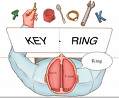
The best visual stimuli for developing babies' vision are bold, black and white patterns with lots of contrast. With that in mind, and with my glasses slipped down to the tip of my nose librarian style, I selected fabric for my next sewing project.

Newborn babies cannot see much of anything which is why bold, stark patterns are best. If you have exceedingly bad vision (20/500), like I do, you can get a sense of what the world looks like to a newborn baby by looking at things with your glasses off. Forget about making out fine patterns — only the big shapes bordered by significantly lighter or darker shapes stand out, and even they are blurry.


I chose fabric that offered a decent amount of contrast but also had some variety in shapes - some circles, some lines, some squiggles. Different portions of the visual cortex respond to different stimuli based on how lines are oriented so it's important to represent a variety of patterns. I also tried to achieve a variety of textures because tactile feedback is important too, but being in a small town, I had to settle for what I could get. And, I am satisfied I got what I needed for these:

• 'taggie' blanket small enough to take anywhere
• fabric book
• blocks

The blanket will have 9 squares on the front and the red 'minky' fabric on the reverse. Ribbon loops and braids of ribbon will hang from the edges and maybe from in between some of the squares. I may put some cellophane in between the batting in some places so it crinkles when touched.

The book will be 6 inches square and designed to lie open flat. I may add some concentric circles in contrasting colors to the fabric that doesn't have much contrast. Concentric circles appeal to babies, as do simple faces, so I may make one of them too. On some of the pages I am going to put some cellophane in between the batting so there's auditory feedback as well as well as visual stimulation.

The blocks I will save for last and hope to make 6 so each side can have a big, bold letter or number on it in red, white or black felt — for learning the alphabet.

With the scraps, if enough is left over I hope to make some stacking rings. They, like nesting cups, are a good toy for promoting cognitive development. They provide practice in planning, ordering and discriminating sizes.

I think the White Stripes would approve of my fabric selection, don't you?

Friday, November 24, 2006

Animal Eyes

I can pass on "The Natural History of Weasels and Stoats" and also "Western Corn Rootworm," but a few of the other titles featured in the Oxford University Press catalog on Ecology and Evolution titles really look interesting. The most exciting to me is "Animal Eyes."

Back in my grad school days I took a class in stereopsis, the technical term for binocular vision, and chose to write my special project paper on binocular vision in animals other than mammals. Through it I learned that animal eyes are quite diverse, and a few are simply amazing.

We've all heard about the compound eyes of insects - the fancy conglomeration of hundreds of lenses in each eye that form a sort of mosaic tile perception of the world. Those are cool, but they don't provide any binocular depth perception because the lenses of each eye don't coordinate with one another in the organism's brain.

Instead, insects with compound eyes judge distance through monocular cues like texture gradient (finely textured objects are probably nearer), occlusion (if one object blocks another the one that is blocked is farther away), and motion parallax (moving your head from side to side simulates the "camera one," "camera two" effect of binocular vision).
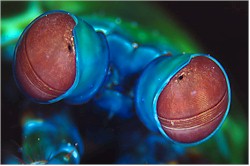
Other animal eyes are way more astounding. Take for instance the mantis shrimp. It has compound eyes but also achieves binocular depth perception within a single eye. Humans, like other animals, need two eyes to have binocular depth perception.

The band that can be seen running horizontally across the mantis shrimp eye separates the two distinct areas above and below. The top and bottom parts of the eye receive different visual inputs (kind of like a right eye vs. left eye), as does the middle band. These areas are coordinated in its brain. Even more amazing is that these three areas are also coordinated with the three matching areas in its other eye, giving it not binocular vision, but hexocular vision.

This animal may have the most complicated eyes on earth. And, that doesn't stop with its perception of depth. This critter also has sophisticated color vision. Whereas humans have trichromatic vision (corresponding to the three different kinds of photoreceptor cells we have in our retinas) that allows us to see light in a relatively narrow range we call the "visual spectrum," the mantis shrimp has four times as many kinds of photoreceptors that allow it to see a much broader spectrum of light, including polarized light.

To find out why these colorful creatures have such complex eyes, check out this entertaining and well-written NWF article.

Some people, such as those who adhere to the Intelligent Design school of thought, think the existence of such intricate biological systems is evidence of an intelligent designer.

The idea can be traced back to William Paley, a theologist who lived around the time that the pocket watch came into common use, who argued that the existence of god could be inferred from the apparent design of the world. He argued that no one, upon stumbling on a rock in a field, would question how the stone got there. But if we instead found a pocket watch, an object that shows evidence of design in that its individual parts work together to produce motion and can be used to keep time, then we would of course question its existence and infer that it had a maker and that it was produced for a reason.

The ID people look at biological systems this way, and not surprisingly, the eye is one of their favorite subjects.

Proponents of ID cannot accept that parts of an eye would be useful in isolation, however, they are. Eyes evolved in small incremental steps, probably starting with a cell that was sensitive to light, followed by patches of cells sensitive to light, then a lens to concentrate the incoming light on the most light sensitive patch, followed by lenses that could concentrate light more exactly, or more than one lens, and so on. No designer is needed, just random changes in DNA that turn out to be beneficial.

Of course one could always just say that the intelligent designer laid down the rules of physics and chemistry and meiosis and then went on permanent holiday never to be seen or heard from again. Questioning how and why the universe came to be in the first place seems to be a human universal, a sort of species typical trait. Perhaps it's the product of consciousness.

Wednesday, November 22, 2006

A Lesson on Acetylcholine From a Simple Eye Exam

Yesterday I had my eyes dilated as part of a routine eye exam. It's been a long time since I had my eyes dilated so I forgot about the side effects. To say that it's "a bit uncomfortable for the patient as it causes increased light sensitivity that lasts for several hours" greatly understates the experience.

According to the University of San Diego School of Medicine, "a non-dilated view of the retina is adequate for a general exam in which the patient has no specific ophthalmologic complaints." Had I only known that yesterday I could have avoided hours of distorted vision that made me queasy and gave me a headache. I did have sensitivity to light, albeit minimal, but elected to shut the lights off in my room anyway. That eliminated the sparkling rainbow halos around the lights which were no good to me anyway as my near vision was so blurry I could not possibly read or do sodoku. That's the real bothersome side effect - and one people should be warned about in advance. If you have to work or be at all productive for the rest of the day you'd be up a creek. Watching a movie was pointless too. I was tempted to call it good and go to bed early, but at five, that seemed crazy.

The short walk home from the doc's office wasn't much fun either. Car headlights looked like a giant Swarovski display case moving at high speed. I felt like how I imagined people must feel while on one of a variety of psychotropic drugs. And, I sort of was "on drugs."

The susbstance used to dilate pupils is a relative of the "belladonna" (beautiful lady) plant so called because the pupil dilation it causes makes people appear to be more beautiful. It's been speculated that people seem to grow in attractiveness with the size of their pupils because pupils naturally dilate when people are interested in something, or someone. Appearing interested makes the person seem more physically attractive. It makes sense - who wouldn't be a little more interested in a stranger simply because he (or she) seems interested?

The chemical, atropine, attaches to the same receptors on the cells of our body that acetylcholine uses. The main job of acetylchone is to contract muscles, whether it's the iris, our forehead or our limbs. When atropine binds to the receptors instead of acetylcholine, muscles relax. The pupil expands. So do the muscles that change the shape of the lens to allow us to focus on near objects in a process called accommodation. The resulting "paralysis of accommodation" simulates what people who need bifocals experience.

Atropine is not the only substance that acts as an acetylcholine antagonist (it blocks its function). Botulin toxin, the stuff responsible for botulism, relaxes muscles too. Small amounts of it is used in Botox beauty treatments to paralyze facial muscles so that they can't produce wrinkles. The chemical eventually wears off, as do the uncomfortable side effects of atropine. Curare, extracted from the bark or a South American tree, is used to poison blow gun dart tips. When curare enters the bloodstream, internal muscles relax and death from asphyxiation can result.

Monday, October 23, 2006

Psychology News Roundup

We all have ideosyncratic facial expressions. My guess is that more than once you've realized that you exhibit some of the same facial mannerisms your parents do. I noticed a while ago that I purse my lips the same way my mom does. Not so long ago my husband commented during a conversation that I had just made a facial expression that is typical of my youngest sister. I really didn't believe him. How could I have picked that up from her, or her from me? We have never lived together and haven't spent a ton of time together. Do families share similar facial expressions? If so, why?

A recently released study in the PNAS suggests there is a genetic basis for shared family facial expressions.
Read more.

*****
In other news, Giant Pandas appear to have some capacity to see in color! Read more here.

*****
Charles Dickens had a keen eye for the observation of neurological disorders, so perfectly describing the symptoms of Tourette's, Parkinson's and "restless legs syndrome" that medical reference texts at the time used his character desciptions. Although he had no formal knowledge of psychological conditions, he had tremendous skills of observation. Read more here.

Pulfrich's Pendulum

The teaching of psychology listserve I subscribe to presented an interesting vision demo that I haven't tried yet, but want to.

Here's how it goes:
Slowly swing a golf ball attached to a string from side to side. The string should be about 3.5 feet long. You'll need to stand on a chair or table for this to work well. Students hold a shaded filter over one eye while viewing the moving ball. A 2 inch square of colored transparent material will work just fine. They will perceive the ball moving in a circular fashion. When you have them move the filter to the other eye, the ball will move circularly in the opposite direction.

Why does this happen?

Lower contrast stimuli are perceived by our visual system to more slower than higher contrast stimuli. The filter reduces the contrast in just one eye so the subjective speed of the ball in that eye is slower. It appears to lag behind. To the brain, that difference in speed is perceived as a disparity between the two eyes in the distance of the object. The resulting impression is a ball moving along an elliptical path. The illusion is known as Pulfrich's pendulum

More interesting apparent motion information can be had here.

That website suggests that a similar effect can be achieved by watching a TV set to a vacant channel with one eye covered by sunglasses. The "snow" will appear to swirl. Switch the filter to the other eye and it will swirl in the other direction.

Stereoblind people, who can't fuse random-dot stereograms (i.e. MagicEye pictures), still perceive the apparent motion of the Pulfrich pendulum. The authors conclude that stereoblind people retain some residual binocular mechanism for depth perception.

The apparent motion effects caused by difference in contrast arise from the different speeds that neural impulses have when conducted down the optical nerve. High contrast stimuli travel faster. The symptoms of multiple sclerosis result from slower neural conductivity brought on by the deterioration of the myelin that insulates the axons of neurons. Without insulation, electrical impulses travel slower. It's possible that people with MS, cataracts, or some other neurological condition that affects the speed of neural impulses in just one eye could experience Pulfrich-like effects.

Friday, October 13, 2006

An Island of Colorblindness

I don't spend much time thinking about what life would be like if I couldn't see the difference between cyan, turquoise, indigo, cerulean, and azure or even between red and green, but after watching Oliver Sacks documentary "An Island of Colorblindness" I have a whole new appreciation for being a trichromat. The documentary chronicles the rare condition of achromatopsia that affects many of the residents of Pingelap, an atoll in the South Pacific. People with the condition see entirely in shades of gray.


Achromatopsia is caused by a genetic mutation that results in the complete or partial absence of cones, the retinal cells that translate photons of light into color with a bit of help from the brain. Light doesn't have any color to it all; color is a construction of our visual system. For the people with achromatopsia on Pingelap, vision that is dominated by rods instead of cones presents its own set of challenges. They have poor visual acuity and sunlight is very painful. They look down virtually all of the time during the day, squint, and blink a lot.

Now that sort of photophobia was actually something I could empathize with; I've experienced that fairly often and acutely so after a brush with something called microcystic edema. I had extreme sensitivity to light, couldn't see to read unless I held the pages about 5 inches from my face, and saw huge rainbow halo around lights. It was awful - there was no treatment, no correction for my vision available - but fortunately it cleared up on its own and hasn't appeared since. Phew. I also stopped wearing contact lenses.

That's probably the last time I thought seriously about vision until I took a graduate level class on vision. I've thought about it a lot since then too. As a psychology professor it's an occupational requirement. And as a primatologist I've read a paper or two about the evolution of color vision among primates. Some species of monkeys are dichromats - they have only two kinds of cones and see much like what most people think of when the term colorblind comes up. Scientists believe the ability to distinguish red from green helped newly evolving diurnal monkeys spot edible leaves and fruit better in the daytime. Previously, monkeys had been nocturnal and ate insects and tree sap. Monkeys who could distinguish colors in the daytime could exploit new niches. They thrived. As a dabbler in art, I appreciate matching and mixing colors for the most pleasing aesthetic effect. But, I take for granted the ability to actually see in color.

Los colores son mi vida is the motto of my impressively talented and successful mother-in-law who weaves multi-colored palettes of yarn into beautiful fabrics. My husband weaves too. They have an entire vocabulary of color terms that never fails to impress me when I eavesdrop on their plans for "warping the loom." I might look at a selection of threads and call them purple while they toss around terms like plum, violet, lavender, eggplant and more. While watching the story of the Pingelapese I was struck by how totally unnecessary such an advanced linguistic library would be for them.

Friday, October 06, 2006

Split Brain

Last night's episode of Grey's Anatomy depicted a patient who underwent a "corpus callosotomy" and then was unable to identify his wife, baby, and a simple object in the room (a cup placed in front of him).

This didn't jive with my understanding of the effects of the procedure, also called a "split brain" operation in psychology. It's a topic that gets brought up in intro psych classes because severing the corpus callosum (a bundle of neurons that connexts the two hemispheres of the brain) produces very interesting side effects that stem from the lack of coordination between the two halves of the brain. It provides a neat case study for understanding how the hemispheres work and also showcases the concept of lateralization - the idea that some functions (such as language) are "specialized" and carried out on one side of the brain.

As the show correctly implied, a split brain procedure is done to treat severe seizures. Cutting the nerve bundle limits the spread of the seizure to the whole brain and greatly reduces the severity of the tremors. It can be done in two stages - the first cutting only the front two thirds of the fibers, leaving the rest intact so the the hemispheres can still share some information. If the seizures are still problematic, the rest of the fibers can be cut.

A full corpus callosotomy creates some interesting side effects - but not the severe one depicted on the show of not being able to identify anything.

What actually happens is that the "split brain" person cannot say out loud the name of an object that is ONLY presented to the LEFT visual field (if the person is left hemisphere dominant for language). The patient would have to close the right eye completely for this to happen. In laboratory tests, split brains look at objects through a tachistoscope that presents information to only one hemisphere or look at image that is flashed briefly to one side of the visual field.

A left hemisphere language dominant "split brain" who viewed an object (spoon, as in the diagram) with only the left visual field would not be able to identify it because that visual input is received by the right hemisphere which can't communicate with the left hemisphere where speech is generated. The person would recognize the spoon but be unable to say it. If asked to pick up the object with the left hand (which is controled by the right hemisphere, the one that saw the object) out of a collection of objects out of sight, the person would correctly pick up the spoon.

These kinds of effects don't usually cause problems for the person because information comes in through both eyes!!!

That's where Grey's Anatomy only captured half of the story. They dumbed it down considerably and even played up a seriously dumbed down version of the brain lateralization story. "McDreamy" the brain doctor said, in explanation of the patient's side effects, that it will take a while for emotional messages to travel to the other side of the brain where information is processed.... or something like that. I wanted to gag.

Anyhow, if you'd like to learn more about split brains, the study of which won Roger Sperry the Nobel Prize for medicine, check out this cool site:

A split brain game you can play.

One of the things that helps to understand, on a deeper level, why the split brain person experiences these weird side effects is that the eyes are connected to the hemispheres in a really unsual way.


The right half of each eye's retina projects to the right hemosphere (shown in dark grey in the diagram above) while the left half of each retina (white) projects to the left hemisphere. Also, half of the retinal fibers (the nasal halves, closest to your nose) cross over to the other hemisphere at the optic chiasm. This means that the temporal halves (the right side of your right eye and the left side of your left eye) don't cross over at all. Your nasal retinal halves can be completely blocked and you'll still have a full field of view because the temporal halves cover the whole field. If you don't believe me or the diagram, hold three fingers right in front of your nose.

I could deliver an emancipation proclamation of the the evolutionary reasons for this weird set up, but suffice it to say that this arrangement allows us to have excellent depth perception.

It also means that a split brain person only receives information that can be verbally identified by one fourth of the available retinal area - the quarter that projects to the right visual field which is on the left side of the left eye (shown in white in the diagram). Notice those fibers don't cross to the other hemisphere; they are the ONLY fibers that project straight back to the left hemisphere. So, only information presented to the right visual field can be verbally identified.

All of this makes me wonder - is the optic chiasm cut during the corpus callosotomy and if so, does the person lack depth perception?

I assume it is cut because all of the textbooks on the subject present the fancy little images of the right and left visual fields and the projections to the nasal and temporal halves, but the side effects would be the same if the retinal inputs could cross over because the two retinal halves would see the same thing. In that case, the brain could still compute the difference in distance from the right and left eye's inputs and triangulate the distance.

Anyhow, that's probably more than you wanted to know about why I thought Grey's Anatomy flunked last night in the way they presented the split brain patient. It's great - I'm glad they did. Maybe somewhere out there someone taking intro psych watched it and realized the same thing I did and actually asked their psych prof about it later.

Tuesday, October 03, 2006

Impossible Things

This week's introductory psychology class introduced students to a magician's take on optical illusions. His name is Jerry Andrus and a little googling found that he makes appearances every so often in Corvalis, OR. Besides introducing young people to the wonders of the Monte Hall problem and a rotating spiral illusion, he constructed an impossible box that I think is very neat.

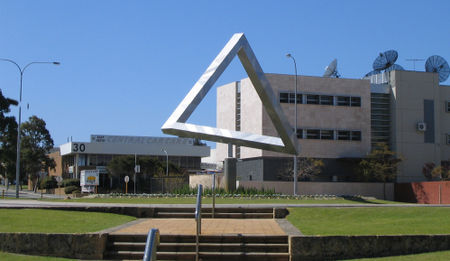
It's very similar to the Penrose triangle illusion. A larger than life one can be seen in Australia (see the photo to the right). There's also one located on the campus of Willamette University in Salem, OR. No Photoshopping tricks are involved. Just arrange the elements the right way and take the photo from the perfect vantage point. If you've got the time, it is possible to create a desk sized impossible triangle out of cardboard.

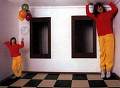
The Ames room is another neat optical illusion that plays on the way our sensory system processes depth. The two girls are identical twins yet one appears much larger. The diagram below shows how the room is constructed. If you have time, a desk sized one could be made. Two pennies could take the place of the girls.

What's really weird is that a couple of psychologists found that when women view their spouse inside an Ames room, they perceive less size distortion than when viewing a stranger! This effect didn't occur for men viewing their wives though, and the degree of distortion perceived was inversely related to how much love and trust each woman felt for her husband.

This shadow illusion is fun. When looking at the shaded squares it is difficult to believe they are actually the same color as the "darker" unshaded squares in the checkerboard.

Can you believe these two tables are exactly the same size?

Thursday, August 10, 2006

Kinkaku Illusion

If you enjoyed the cool illusion I posted earlier and have been to Japan, you might enjoy this version of that illusion even MORE.